Nyeri irrigation project to transform 834 acres of farmland
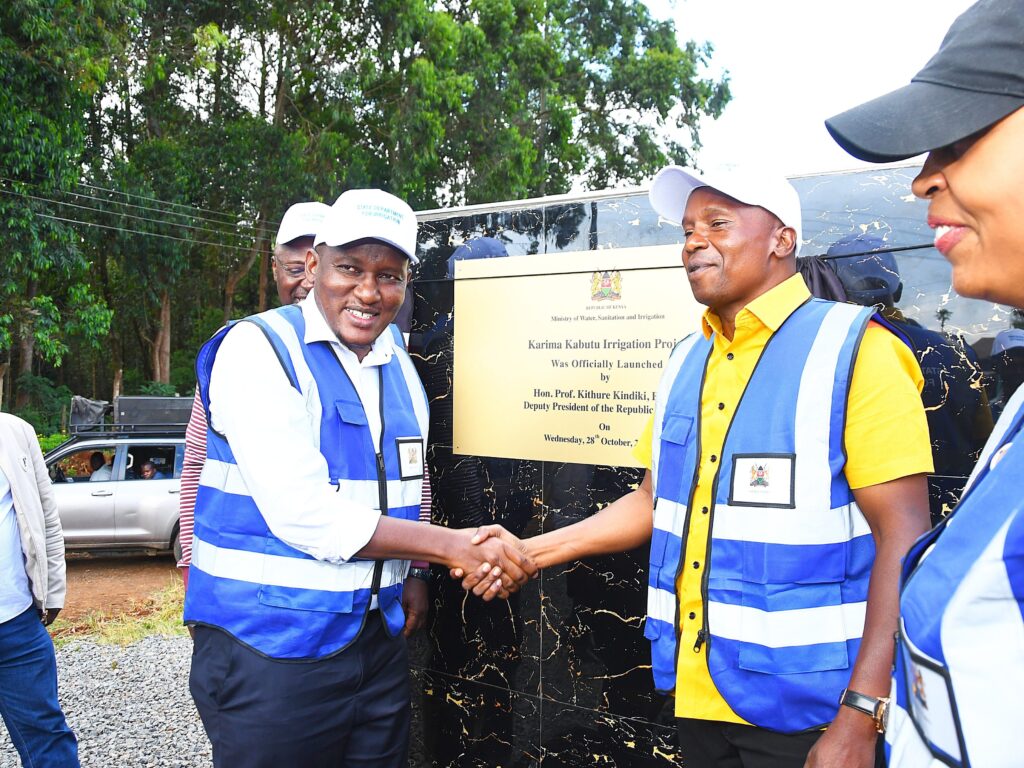
The Government has launched the Karima Kabutu Irrigation Project in Othaya Constituency, Nyeri County, in a move aimed at increasing agricultural production, improving household incomes and strengthening food security.
Deputy President Kithure Kindiki presided over the launch alongside Principal Secretary for Irrigation Ephantus Kimotho, reaffirming the Government’s commitment to accelerating irrigation development as part of efforts to improve rural livelihoods and reduce the impact of climate change on farming.
The project is expected to provide a reliable water supply for agriculture across approximately 834 acres of land, benefiting an estimated 1,668 households. It will enable farmers to expand crop production beyond the rainy seasons and diversify into higher-value horticultural and food crops.
Planned crops include cabbages, tomatoes, peas and potatoes, as well as fruit trees. With dependable irrigation water, farmers are expected to improve crop yields, reduce losses associated with unreliable rainfall and establish more consistent production throughout the year.
The investment is also expected to create employment opportunities in farming, harvesting, transportation and agricultural marketing, while supporting the growth of agribusiness within the project area.
The project will involve the construction of water intake facilities, sedimentation tanks and conveyance pipelines, alongside a main pipeline and sub-mains to distribute water across the scheme.
Two distribution systems will serve the Iriaini and Witima areas. The works will also include in-field irrigation systems and supporting infrastructure such as gulley and river crossings.
These facilities are intended to improve water distribution to farms and enable farmers to make more effective use of available water resources.
Beyond agricultural production, the project is expected to provide water for domestic use, helping to improve living conditions for communities within the scheme. Its implementation is also expected to support local economic activity by increasing demand for farm inputs, labour and produce-handling services.
Financial and economic assessments indicate that the Karima Kabutu Irrigation Project is expected to generate gross annual income of approximately KSh227 million, with an estimated payback period of two years.
Farmers are projected to earn an average gross annual income of about KSh750,000 per acre, highlighting the anticipated economic potential of irrigated agriculture in the area. These figures are projections rather than guaranteed earnings. Actual returns will depend on production costs, crop yields, market prices, access to buyers and the reliability of water supplies.
The project is also expected to strengthen drought preparedness by reducing farmers’ dependence on rainfall. This is particularly important as changing weather patterns continue to expose agricultural production to periods of water scarcity and unpredictable growing seasons.
Reliable irrigation can help farmers plan planting cycles more effectively and maintain production when rainfall is inadequate, provided water resources are managed sustainably.
The Karima Kabutu scheme aligns with the Government’s Bottom-Up Economic Transformation Agenda, which prioritises food security, agricultural productivity, employment creation and improved household incomes.
By expanding irrigation infrastructure, the project is intended to support a shift from predominantly rain-fed farming towards more productive and climate-resilient agriculture.
Its long-term impact will depend on timely completion of the infrastructure, effective water management, maintenance arrangements and farmers’ ability to access markets for their produce.
If the projected benefits are realised, the scheme could provide participating households with opportunities to diversify production, increase farm earnings and strengthen their resilience to climate-related disruptions.
The launch adds to Kenya’s broader irrigation development agenda, which seeks to increase agricultural output, improve rural livelihoods and strengthen the country’s capacity to produce food under increasingly variable climatic conditions.