Explainer: How is Nairobi’s water supplied from source to tap?

Every day, water used in Nairobi’s homes, offices, schools, hospitals, hotels and industries begins a journey that may start dozens of kilometres away in the forests and river catchments of central Kenya. It flows through rivers, reservoirs, treatment plants, transmission pipelines and storage facilities before reaching the distribution network that supplies consumers across the capital.
Although turning on a tap appears simple, delivering safe and reliable water to a rapidly growing city requires an interconnected system of natural resources, engineering infrastructure and public institutions. Rainfall in the Aberdare ranges, the condition of rivers feeding major dams, the capacity of treatment plants, the maintenance of pipelines and the management of urban demand all influence how much water ultimately reaches consumers.
Nairobi’s water supply therefore extends well beyond the boundaries of Nairobi County. The city depends heavily on water resources in neighbouring counties, particularly Murang’a, Nyandarua and Kiambu, making catchment conservation and cooperation between different regions essential to its long-term water security.
The Nairobi City Water and Sewerage Company manages water and sewerage services within its area of responsibility, while the Athi Water Works Development Agency develops major public water and sewerage infrastructure. Their complementary roles connect the collection of raw water outside the city with the delivery of treated water to households and businesses.
At the beginning of this system are the catchments that collect rainfall and feed rivers supplying Nairobi.
Most of the city’s conventional piped water originates in the eastern Aberdare catchments and the upper Tana River basin. Rain falling across these highland areas feeds rivers and streams that supply reservoirs and water intakes. The resulting water is collected and conveyed through infrastructure designed to provide a relatively dependable supply throughout the year.
The condition of these catchments is critical. Forests, wetlands, vegetation and healthy riverbanks help regulate runoff, limit erosion and reduce the amount of sediment entering rivers. When land is degraded, riverbanks are disturbed or pollution enters waterways, the effects can extend downstream to reservoirs and treatment plants.
Heavy sediment loads can increase treatment requirements, while pollution can introduce contaminants that require additional monitoring and treatment. Droughts and changing rainfall patterns can also reduce the volume of water available for abstraction, putting pressure on reservoirs and increasing the risk of supply restrictions.
For Nairobi, protecting water sources is therefore not simply an environmental concern. It is part of the infrastructure needed to sustain the city’s economy and population.
Four established sources form the foundation of Nairobi City Water’s conventional piped supply: Thika Dam, commonly known as Ndakaini Dam; Sasumua Dam; Ruiru Dam; and Kikuyu Springs. These sources feed the treatment facilities that supply the city, although their individual contributions vary according to operating conditions and water availability.
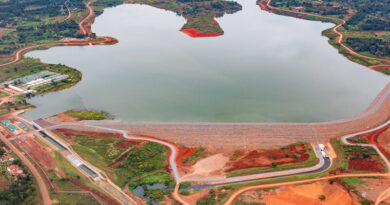
Thika Dam, located in Ndakaini, Murang’a County, is the principal reservoir in the system. Completed in 1994, it has a designed storage capacity of 70 million cubic metres, equivalent to 70 billion litres. Its catchment covers approximately 75 square kilometres, and a four-kilometre tunnel links the reservoir to the Chania River system serving Ng’ethu Water Treatment Works.
According to Nairobi City Water, the Thika Dam system contributes approximately 84 per cent of the city’s water supply. Its importance means that rainfall, river flows, reservoir storage and the condition of the infrastructure connected to Ndakaini have a substantial influence on water availability in the capital.
The dam stores water collected from rivers draining into the reservoir, including the Thika, Githika and Kayuyu rivers. Water is then released into the supply system and conveyed for treatment before being transmitted towards Nairobi.
A second major source is Sasumua Dam in Nyandarua County. With a storage capacity of approximately 15.9 million cubic metres, the reservoir is situated on the Sasumua River and receives water from the surrounding catchment, including the Kibiru and Chania streams.
Sasumua has its own treatment facility and provides an additional source for Nairobi. Its contribution is particularly important because the capital cannot depend indefinitely on a single reservoir without exposing the supply system to greater operational and hydrological risks.
Ruiru Dam, in Kiambu County, also contributes water to the city. Water from Ruiru Dam is treated through the Kabete system, which also handles water from Kikuyu Springs.
Kikuyu Springs is a smaller but established source that adds to the range of water resources available to the capital. Although its contribution is substantially lower than that of Ndakaini, it forms part of the broader system used to meet demand.
The relative contributions of these sources are not necessarily fixed. They can change with rainfall, reservoir levels, maintenance activities, treatment capacity and operational decisions. Their combined performance determines the amount of water available for distribution.
The next stage is moving raw water from its source to a treatment facility. This requires intakes, tunnels, channels and large transmission pipelines that connect reservoirs and rivers with treatment works.
One of the major infrastructure investments intended to strengthen Nairobi’s supply is the Northern Collector Tunnel Phase I project. The project was designed to collect water from the Maragua, Gikigie and Irati rivers in Murang’a County and transfer it towards Ndakaini Dam.
The system includes a 12-kilometre transfer tunnel and associated intake structures. Its purpose is to capture part of the rivers’ available flows, including floodwater, and direct it into the existing reservoir system, increasing the volume of water that can ultimately be supplied to Nairobi and surrounding towns.
The project is designed to increase water storage capacity by approximately 100 million cubic metres annually. However, that figure represents the intended additional water resource capacity, not a guarantee that the same volume will be delivered to consumers every year. Actual flows depend on hydrological conditions, environmental requirements and operational constraints.
The project also illustrates how Nairobi’s water security depends on infrastructure beyond the city. A tunnel built in the Aberdare region can influence water availability in estates and commercial districts many kilometres away because it changes how water is collected and transferred into the capital’s supply system.
Another major component is the Thika Dam–Kigoro–Gigiri water transmission system. The project links the raw-water supply from the Thika Dam system to Kigoro Water Treatment Plant and provides for the transmission of treated water towards storage facilities in Nairobi.
The wider infrastructure programme includes approximately 55 kilometres of raw and treated water pipelines, together with strategic storage facilities. Kigoro’s stated treatment capacity is 140 million litres per day, giving it a significant role in the effort to increase bulk supply.
The distinction between raw-water transfer and treated-water transmission is important. Raw water must first undergo the necessary treatment processes before it can be distributed as drinking water. Pipelines connecting the source, treatment plant and reservoirs therefore perform different functions within the same overall supply chain.
Once water reaches a treatment plant, it must be processed to remove impurities and control microorganisms before entering the public network.
Raw water collected from rivers and reservoirs may contain suspended soil, organic matter, microorganisms and other substances. Its quality can also change after heavy rainfall, during dry periods or when pollution enters the catchment.
Conventional drinking-water treatment generally begins with screening, which removes larger debris. Coagulation and flocculation follow, using suitable treatment chemicals to help small suspended particles form larger clusters. These clusters can then settle in sedimentation tanks.
The partially clarified water passes through filtration systems that remove remaining fine particles. Disinfection, commonly using chlorine, helps inactivate disease-causing microorganisms and provides residual protection as water moves through the distribution network.
The exact treatment process and chemical dosing depend on the characteristics of the raw water and the requirements of the individual plant. Treatment operators must monitor performance and ensure that the finished water complies with applicable drinking-water standards.
Water quality monitoring also extends beyond the treatment works. In an article published on October 14, 2026, Nairobi City Water Managing Director Martin Nang’ole described a source-to-tap monitoring programme covering catchments, treatment plants and the distribution network.
The company reported that it operates more than 300 designated water-sampling points and collects approximately 640 samples each month for analysis. The monitoring programme covers physical and chemical indicators, including pH, colour, turbidity and residual chlorine, as well as microbiological indicators such as total coliforms and E. coli.
The company also described regular checks at treatment plants to verify that treatment processes remain effective. Such monitoring is essential because safe water must be protected throughout the entire supply chain, not just at the point where it leaves the treatment facility.
After treatment, water enters the transmission and storage system. Large pipelines carry it towards reservoirs that hold treated water before it is distributed through the city’s network.
Storage is an important part of the process because production and consumption do not remain constant throughout the day. Households may use more water during morning and evening periods, while hospitals, schools, hotels and industries have their own consumption patterns.
Service reservoirs help balance these variations, maintain pressure and provide a buffer when production or pumping is interrupted. They also help utilities distribute water across different parts of the city without requiring treatment plants to respond immediately to every change in demand.
Nairobi’s wider network includes reservoirs and storage facilities serving areas such as Gigiri, Kabete, Kiambu, Uthiru, Dagoretti, Embakasi, Kasarani and other locations. These facilities connect major transmission mains with smaller distribution systems.
Depending on elevation and the design of the network, water may flow by gravity or require pumping. From the major transmission lines, it passes into secondary pipes and then smaller local distribution pipes serving estates, commercial centres and individual properties.
At the consumer end, water usually passes through a service connection and meter before entering a property’s plumbing system. Some buildings use additional storage tanks and pumps to manage pressure and maintain supplies, particularly where water must be lifted to upper floors or where service is intermittent.
For residents, this final stage is where the performance of the entire system becomes visible. A household may have a functioning connection but still experience unreliable supply if water production is insufficient, pressure is low or the surrounding distribution network cannot meet local demand.
This helps explain why Nairobi can have large dams and modern treatment infrastructure while residents in some neighbourhoods continue to experience rationing.
The central challenge is the difference between the volume of water available and the amount required by the city. Nairobi’s demand has grown alongside its population, housing developments, commercial activity and industrial operations. The expansion of the metropolitan area has also increased the need to extend pipelines and storage infrastructure to additional settlements.
Figures reported in recent years vary according to the date, the areas included in the calculations and whether they refer to installed production capacity, actual output or estimated demand. A 2026 report by Business Daily placed daily demand at approximately 935,000 cubic metres, against reported supply capacity of 658,600 cubic metres.
On those figures, the gap is approximately 276,400 cubic metres per day, meaning the reported supply capacity is about 70 per cent of estimated demand. These numbers should not be confused with a direct measurement of the water received by every household, since distribution losses and local network constraints affect the volume that ultimately reaches consumers.
Several factors contribute to the supply challenge.
The first is population growth. More residents require water for drinking, cooking, bathing, cleaning and sanitation. Businesses, schools, hospitals and other institutions add to demand, while new housing developments create additional pressure on existing pipelines and reservoirs.
The second is the dependence on rainfall-sensitive sources. Although reservoirs provide storage, prolonged dry periods can reduce river flows and limit the amount of water available for treatment. Climate variability makes long-term planning more difficult because infrastructure must accommodate both changing demand and fluctuations in available resources.
The third is water loss within the distribution network. Leaks, bursts, illegal connections and inaccurate metering can reduce the volume of water accounted for by the utility. Non-revenue water is a broader measure that includes physical losses and water supplied but not properly billed or recorded. Reducing it can improve the amount of water available to consumers without requiring an equivalent increase in abstraction from rivers and dams.
The fourth is the condition and capacity of existing infrastructure. Pipelines require regular inspection, maintenance and replacement. Emergency repairs may temporarily interrupt supply, while insufficient network capacity can prevent additional treated water from reaching some neighbourhoods even when production increases.
Finally, supply is not distributed equally across the city. Areas differ in elevation, distance from major supply lines, network design and demand. Some neighbourhoods receive water more regularly than others, while households facing intermittent service may depend on storage tanks, kiosks, vendors or private boreholes.
These alternatives can help meet immediate needs, but they also create differences in cost and reliability. Residents who buy water from vendors may pay more per litre than consumers receiving piped water, and the safety of alternative supplies depends on their source, handling, storage and testing.
Groundwater is another part of Nairobi’s wider water picture. Private and institutional boreholes supplement the public network, but groundwater should not be regarded as an unlimited reserve. Sustainable abstraction requires knowledge of aquifer conditions, recharge rates and cumulative withdrawals. Borehole water must also be tested and treated where necessary before it is considered suitable for drinking.
The institutions responsible for water management therefore face a task that extends beyond constructing additional dams and pipelines. They must coordinate water-resource protection, treatment, storage, distribution, maintenance and consumer service.
Nairobi City Water and Sewerage Company manages the delivery of water and sewerage services within its area of responsibility. Athi Water Works Development Agency develops major public infrastructure, including bulk water supply and transmission facilities. The Water Services Regulatory Board regulates water service providers and oversees service standards, while the Water Resources Authority is responsible for regulating water resources and abstraction within its mandate.
The Ministry of Water, Sanitation and Irrigation provides national policy direction, while environmental authorities and county institutions have roles in protecting catchments, managing land use and addressing pollution.
These responsibilities are interconnected. A new treatment plant cannot deliver its intended benefits if transmission pipelines remain constrained. A large pipeline cannot solve shortages if insufficient raw water is available. Equally, additional bulk water will not necessarily improve service in every estate unless local distribution pipes, storage facilities and operational arrangements can carry it to consumers.
Nairobi City Water’s 2024/25–2028/29 strategic plan identifies reducing non-revenue water to 30 per cent and adding 50,000 new water and sewer connections during the plan period as priorities. The plan also identifies additional sources, including Maragua IV, Ndarugu and Northern Collector Tunnel Phase II, as important to meeting projected future demand.
These initiatives point to a broader strategy: increasing the volume of water available while improving how efficiently the existing supply is managed and distributed.
For the strategy to succeed, catchment conservation must remain a priority. Protecting forests, restoring riverbanks and reducing pollution can help preserve the quality and reliability of the water entering reservoirs. Water-resource planning must also account for the needs of communities and other users sharing rivers and catchments outside Nairobi.
Infrastructure investment must be accompanied by maintenance and better operational management. Utilities need reliable production data, effective metering, timely leak detection and sufficient funding to maintain treatment works, pumping stations, reservoirs and pipelines. Accurate monitoring can help identify where water is being lost and which parts of the network need urgent intervention.
Water quality must also remain central to the system. Regular testing at sources, treatment plants, reservoirs and distribution points helps identify problems before they affect large numbers of consumers. Protecting pipes against contamination and ensuring that storage facilities are properly maintained are equally important.
Residents also have a role in reducing avoidable waste by repairing leaking household fittings, maintaining clean storage tanks and reporting visible leaks. These actions cannot replace the need for investment in public infrastructure, but they can support more efficient use of available supplies.
Ultimately, Nairobi’s water supply is a chain that begins with rainfall and healthy catchments, passes through dams and rivers, depends on treatment and transmission infrastructure, and ends with the ability of the distribution network to deliver safe water to individual consumers.
The capital’s water security will depend on making every stage of that chain work more reliably. More water must be collected and treated where resources permit, losses must be reduced, infrastructure must keep pace with demand, and water quality must be protected from source to tap.
For Nairobi residents, the real measure of progress is not simply the capacity of a dam or the completion of a treatment plant. It is whether safe, affordable and dependable water reaches homes, businesses and public institutions when it is needed.