Garissa advances groundwater projects for water Security
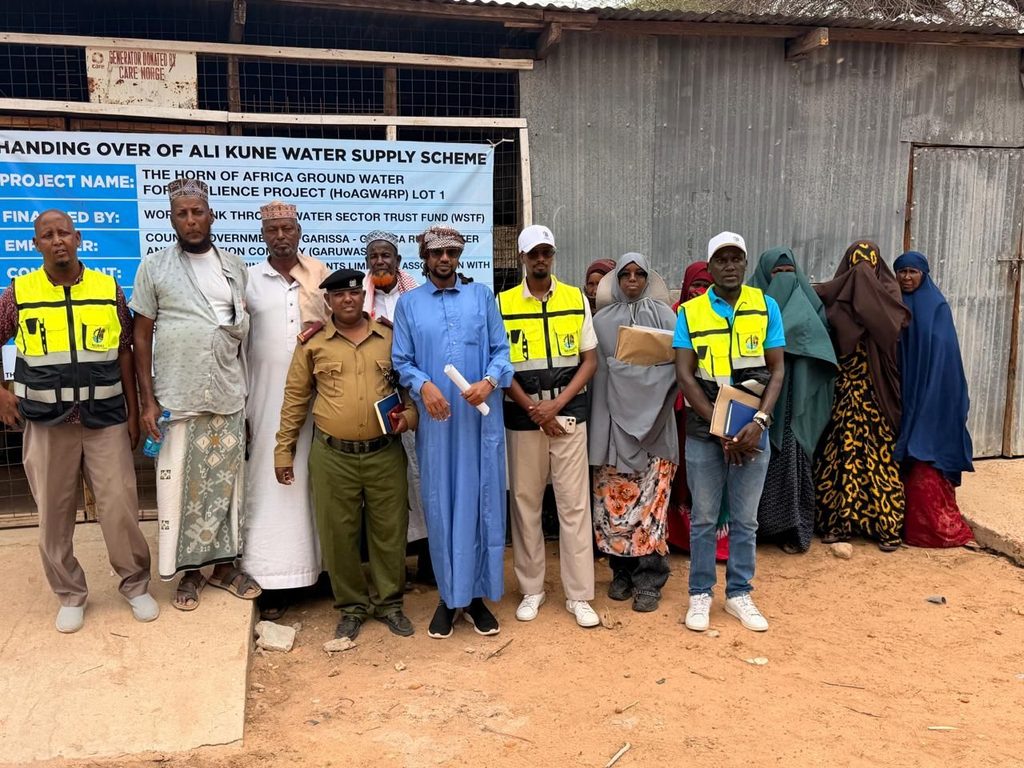
Four water supply schemes in Garissa County are set for rehabilitation and expansion following the handover of construction sites to Nurki Construction Company Limited under the Horn of Africa Groundwater for Resilience Project (HoAGW4RP).
The Ali Kune, Baraki, Medina and Shanta Abak schemes currently serve an estimated 13,330 people. The planned improvements are expected to strengthen water supplies for households, schools, health facilities and livestock in the drought-prone county.
The works will include upgrading borehole pumps and solar power systems, laying more than 26 kilometres of pipelines, expanding water storage capacity and constructing or rehabilitating water kiosks, livestock watering troughs and sanitation facilities.
The handover marks the start of preparations for construction, with the contractor expected to mobilise equipment and personnel before commencing work. The improvements aim to enhance water distribution and reduce supply interruptions in communities that rely heavily on groundwater.
The handover brought together project representatives, the contractor, supervising consultants, local administrators, community elders and representatives of women and youth. Residents were briefed on the planned works, the teams responsible for implementation and what to expect during construction.
Discussions also covered environmental protection, worker and community safety, and measures to prevent sexual exploitation, abuse and harassment. Residents were reminded of the project’s Grievance Redress Mechanism, which provides channels for reporting complaints and concerns throughout implementation.
The works fall under HoAGW4RP, implemented through the State Department for Water and Sanitation in the Ministry of Water, Sanitation and Irrigation, with financing from the World Bank.
The wider programme targets five arid and semi-arid counties in Kenya: Garissa, Wajir, Mandera, Marsabit and Turkana. It seeks to improve sustainable access to groundwater and strengthen the capacity of communities and institutions to manage the resource in areas exposed to recurring droughts and water shortages.
The initiative recognises groundwater as a strategic resource in the Horn of Africa, where rainfall is often irregular and rivers, pans and other surface-water sources may dry up during prolonged dry spells. Properly developed and managed aquifers can provide a more dependable source of water for domestic use, livestock production and other community needs.
Beyond improving water infrastructure, groundwater resilience requires reliable information about underground water reserves, their quality, recharge rates and patterns of use. Such information helps authorities determine where boreholes should be developed, how much water can be safely abstracted and which areas require closer monitoring.
This is particularly important in Garissa, where high temperatures and recurrent droughts place pressure on limited water resources. While boreholes can improve access, excessive abstraction may lower groundwater levels, increase pumping costs and threaten the long-term reliability of supplies. Protecting groundwater quality from contamination is also essential for public health.
The programme’s infrastructure investments therefore need to be supported by effective maintenance, water-quality monitoring and responsible groundwater management. Upgrading solar-powered pumping systems can help reduce reliance on conventional energy sources, while adequate storage and expanded distribution networks can improve the delivery of water to households and livestock.
Community participation is another important part of sustainable water service delivery. Involving residents in project implementation and providing clear channels for complaints can help identify local concerns, promote accountability and support the protection of completed facilities.
For the four Garissa schemes, the next stage will involve contractor mobilisation, construction and continued technical supervision. Once completed, the upgraded facilities are expected to improve water storage and distribution, helping the communities they serve cope with dry conditions and unreliable surface-water supplies.
The investment forms part of wider efforts to strengthen groundwater management and build climate resilience across Kenya’s arid and semi-arid regions, where reliable water supplies are critical to household welfare, livestock survival and local economic activity.