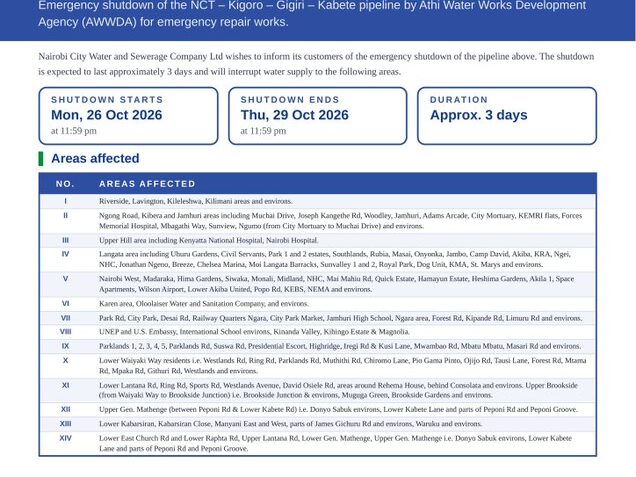
Mavoko water announces shutdown for pepair works
Mavoko Water and Sanitation Company is pursuing additional water sources, expanded distribution networks and improved sanitation infrastructure to address a significant supply deficit affecting communities in Mavoko Sub-County, Machakos County.
The utility estimates that the area faces a water supply shortfall of approximately 30,000 cubic metres per day, underscoring the need for increased production, additional bulk water supplies and investment in distribution infrastructure.
According to the company’s published information, its strategy combines the development of new water sources, rehabilitation of existing facilities and expansion of pipelines to reach underserved neighbourhoods. The initiatives are intended to improve the reliability of water services as residential developments, businesses and industries increase demand across the area.
One of the key infrastructure investments is the Mavoko Water Supply Project, which is designed to deliver 12,000 cubic metres of water daily to Mavoko and an additional 5,000 cubic metres to Syokimau. The project targets approximately 250,000 people.
The planned infrastructure includes a treated-water pipeline connecting the General Motors area to Syokimau, a 5,000-cubic-metre ground reservoir and a 3,000-cubic-metre elevated storage tank. According to the water company’s project update, the two storage facilities are complete, while the Nairobi–Syokimau pipeline component remains ongoing. The latest implementation status should be confirmed with the agency before publication.
The investment is expected to strengthen water storage and distribution capacity, particularly in areas experiencing increased demand. Storage facilities can help utilities manage supply fluctuations, while expanded transmission and distribution networks are essential for delivering treated water to homes, institutions and commercial establishments.
Mavoko Water also relies on bulk supplies from Nairobi City Water and Sewerage Company. Water abstracted from the KMC and Portland dams in Athi River is treated before being distributed to Athi River town, Greatwall Gardens, Gimu, Green Park, Lukenya, Daystar and neighbouring communities.
The company additionally obtains water from boreholes, reporting approximately 7,000 cubic metres of monthly production from these sources. In informal settlements and low-income neighbourhoods, water kiosks provide another means of distributing water to residents. The utility is also introducing automated dispensing units at kiosks to improve convenience and operational efficiency.
To increase production and reduce the supply gap, the company lists several initiatives being pursued with government and water-sector partners. These include desilting the KMC and Portland dams, developing the proposed Stoni Athi and Ndarugu dams, exploring bulk supplies from Olooloitikosh Dam, and drilling or rehabilitating boreholes.
Pipeline extensions are also planned for areas including Syokimau, Mlolongo, Kinanie, Utawala, Githunguri, Joska, Kamulu and Kyumbi. Their implementation will be important in ensuring that increased production translates into improved household access.
Alongside water supply, sanitation infrastructure remains a priority. Mavoko Water has set a strategic objective of increasing sewerage coverage to 40 per cent by 2028. The company is also promoting sanitation interventions in vulnerable communities, including public sanitation facilities, handwashing facilities and school water, sanitation and hygiene programmes.
The utility is further targeting a reduction in non-revenue water from 34 per cent to 25 per cent through technology adoption and stronger operational capacity. Its published plans include piloting smart metering and implementing District Metered Areas to improve monitoring of water flows and identify potential losses. Reducing water losses can help utilities make better use of available supplies while strengthening financial sustainability.
Climate resilience is another consideration in the company’s planning. Mavoko Water reports that prolonged droughts and flooding can disrupt service delivery, prompting catchment protection initiatives and efforts to increase resilience, including the adoption of green energy solutions.
The scale of the supply deficit means that expanding water production must be accompanied by reliable bulk supplies, effective distribution, reduced losses and sustained investment in sanitation. Coordination among the utility, county government and national water agencies will remain important in advancing these interventions.
While the company’s published plans outline several measures for improving services, updated implementation figures and completion timelines for individual initiatives will be necessary to establish how quickly residents will benefit.
Ultimately, sustained investment in water sources, storage, pipelines and sanitation systems will be essential to meeting Mavoko’s growing needs and supporting healthier communities and continued economic development.