TWWDA targets 90% water coverage as supply expands across five counties
Residents in parts of Kenya’s Mount Kenya region are beginning to experience improvements in water supply as infrastructure investments seek to extend service hours, expand distribution networks and strengthen sanitation systems across five counties.
In Kirinyaga County, improvements to the Kerugoya–Kutus water supply system have enabled residents to receive water throughout the day, extending supply from 18 hours to 24 hours. The change illustrates how upgrading existing infrastructure can improve the reliability of water services for households, businesses and public institutions.
The development forms part of a wider programme being implemented by the Tana Water Works Development Agency (TWWDA), whose mandate covers Nyeri, Kirinyaga, Embu, Tharaka Nithi and Meru counties.
The agency’s Strategic Plan for 2023–2027 outlines an ambition to increase access to quality water services from 57.8 per cent to 90 per cent and raise sanitation coverage from 8.1 per cent to 30 per cent by 2027.
Achieving these targets will require additional water sources, treatment facilities, storage infrastructure, pipelines and sewerage systems, alongside improvements to the management of existing installations.
The agency estimates that implementing its five-year development programme will require KSh63.775 billion. Of this amount, approximately KSh40.87 billion was projected to be available through anticipated allocations, leaving a financing gap of about KSh22.9 billion in the plan.
Water infrastructure development, maintenance and expanded supply account for KSh37.096 billion of the projected requirement, while KSh24.042 billion is earmarked for sanitation. The remaining allocation covers areas such as research, innovation, partnerships and institutional sustainability.
These figures highlight the scale of investment required to meet growing demand in a region where households, businesses and agricultural activities depend on reliable water supplies.
Several projects across the five counties are intended to improve access for communities that have historically experienced inadequate or unreliable water services.
In Nyeri County, the Mathira Community Water Supply Project was commissioned in January 2024 with the objective of benefiting more than 25,000 people.
The project includes three water intakes, 21 kilometres of primary gravity mains, a distribution network extending 74 kilometres and six storage tanks. The infrastructure is intended to improve the movement and storage of water while extending supply to households within the project area.
More dependable water supplies can also support farming activities, reduce the time households spend obtaining water and improve conditions for small businesses that rely on the resource.
In Tharaka Nithi County, improvements to the Kibunga–Kakimiki water supply system are expected to increase the number of people served from approximately 10,000 to more than 20,000.
The intervention focuses on improving the performance of existing infrastructure and reducing water losses, allowing more of the available supply to reach intended consumers. Extending the system’s coverage could also benefit rural households and public institutions that need dependable water for everyday activities.
Embu County is another focus of investment through the Mbeere South Water Supply Project, which is designed to draw water from Kamburu Dam.
The planned infrastructure includes a treatment plant with a capacity of 10,000 cubic metres per day, approximately 150 kilometres of distribution pipelines, transmission mains, storage tanks and connections to individual consumers.
Once fully implemented and operational, the project is expected to serve about 100,000 people.
The system is intended to address persistent water shortages in the area while supporting household needs and creating opportunities for expanded economic activity. Its ultimate impact will depend on completing the required infrastructure and maintaining reliable operations after commissioning.
Together, the projects demonstrate the role of both new construction and improvements to existing systems in expanding water coverage.
Alongside water supply, wastewater management remains a major infrastructure priority for towns experiencing population growth and increasing pressure on existing sanitation facilities.
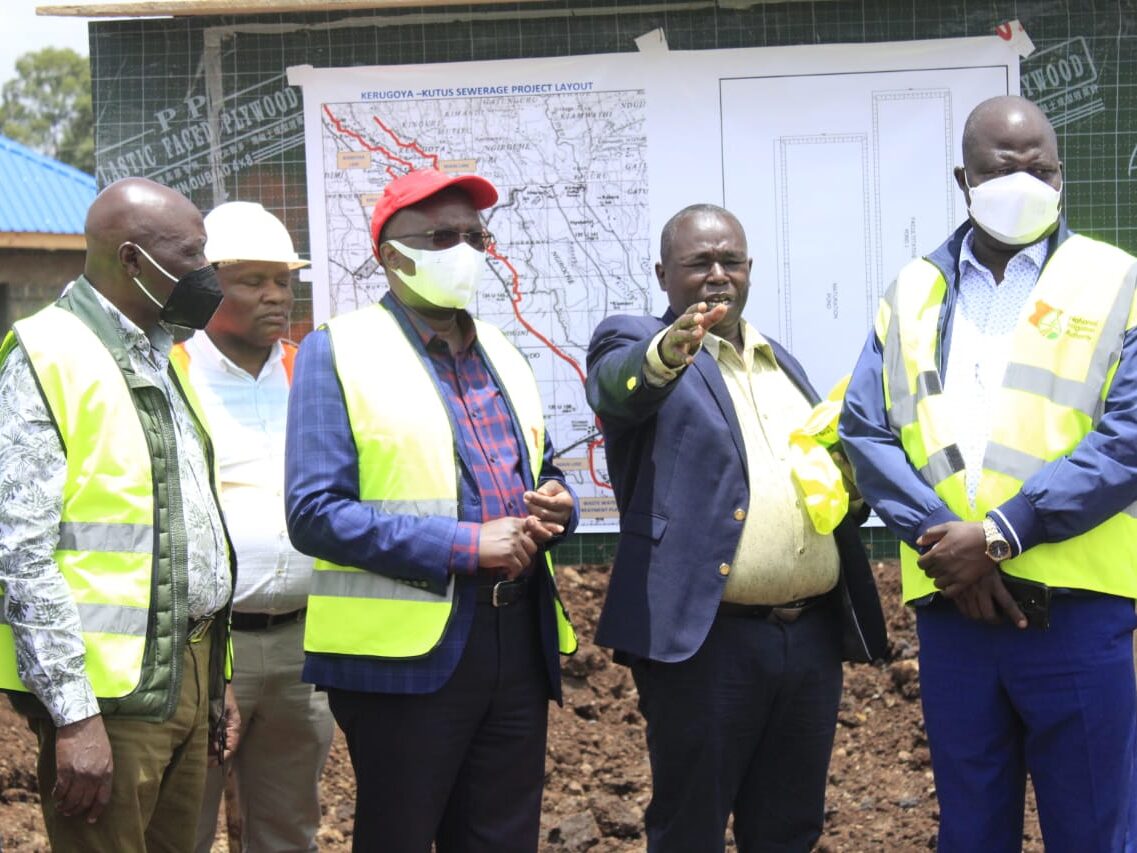
TWWDA is advancing sewerage and wastewater treatment projects in Kerugoya–Kutus, Chuka, Chogoria, Meru and Othaya to improve the collection and treatment of wastewater.
In Kerugoya–Kutus, the sewerage project is designed to benefit approximately 40,000 people through facilities for wastewater collection and treatment.
The Meru sewerage project is intended to improve services for an estimated 193,000 people through expanded sewer networks and wastewater treatment infrastructure.
Projects planned for Chuka and Chogoria are also expected to provide sewer networks and treatment capacity to serve the growing urban populations in the two centres.
These investments are important because inadequate wastewater management can expose communities to public health risks and contribute to pollution of rivers and other water resources. Expanding sewerage networks and treatment facilities can help towns manage wastewater more effectively as residential and commercial developments increase.
However, the benefits will depend not only on construction but also on connections to the systems, effective operation of treatment facilities and adequate resources for maintenance.
The scale of the planned water and sanitation programme means that government allocations alone may not be sufficient to meet all development needs within the proposed timeframe.
TWWDA has identified development-partner support and alternative financing arrangements as potential ways to mobilise additional resources. The agency has pursued engagement with institutions including the African Development Bank and identified other possible partners in its strategic planning.
Public-private partnerships are another potential option for suitable projects, particularly those involving water supply, wastewater treatment, renewable energy and related infrastructure.
The agency has also identified opportunities to diversify revenue through services such as water-bowser operations and bulk water supply.
Such approaches could help strengthen financial sustainability, although their contribution will depend on the terms of individual arrangements, the resources secured and the commercial viability of the proposed services.
Financing construction is only one part of ensuring lasting improvements. Completed infrastructure must also be operated and maintained effectively so that treatment plants, pipelines and storage facilities continue functioning as intended.
Water service providers are particularly important in this process because they manage customer connections and day-to-day service delivery. Their technical capacity, financial performance and ability to maintain distribution networks influence whether investments translate into dependable water supplies for consumers.
Reducing water losses, improving operational efficiency and ensuring that customers receive reliable services will therefore remain important alongside the expansion of infrastructure.
The improvement in Kerugoya–Kutus, where supply has increased from 18 hours to round-the-clock service, provides a practical example of the difference that infrastructure upgrades can make.
For households, more consistent supply can make daily routines easier to manage. Businesses may also benefit from greater predictability, while schools and health facilities require dependable water for essential operations.
Across the wider Mount Kenya region, the planned investments seek to extend similar benefits to communities that remain underserved.
Nevertheless, progress towards the 2027 targets will require sustained financing, timely implementation, effective coordination with counties and water service providers, and careful management of completed projects.
The projected financing gap remains a key consideration as the agency works to expand both water and sanitation services across its five-county area.
Ultimately, the success of the programme will depend on the number of people who receive reliable services, the ability of utilities to sustain those services and the extent to which wastewater is managed safely.
As projects advance, the central measure of progress will be whether more households can depend on water from their taps and whether growing towns have the infrastructure needed to manage sanitation safely and protect local water resources.