Hexing Africa eyes Kenya’s water metering market
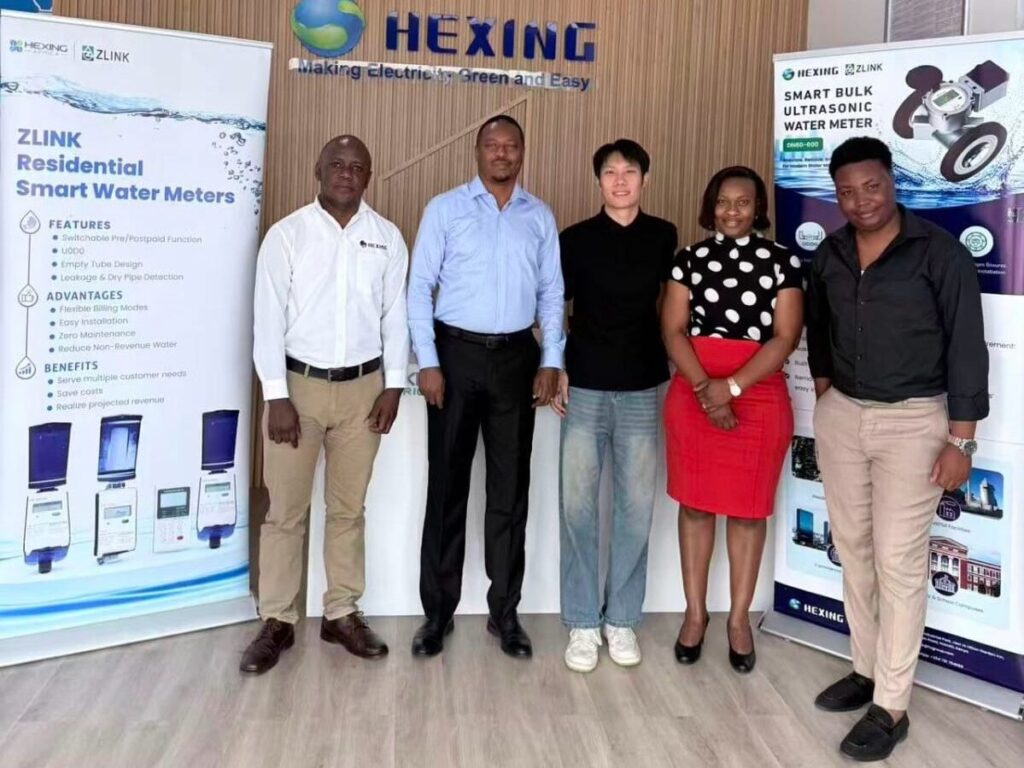
Hexing Africa is exploring opportunities to expand its operations into Kenya’s water sector, introducing a new portfolio of water metering solutions as utilities seek better ways to manage consumption, improve billing and reduce financial losses.
The company’s representatives, led by Country Manager Louis Li, alongside Martin Were and Eben, met Water and Sanitation Providers Association (WASPA) Chief Executive Officer Anthony Njaramba and Maureen Oginya to present the company’s water meter portfolio and discuss its potential application in the local market.
Hexing has built much of its Kenyan business around electricity metering, which the company says accounts for approximately 90 per cent of its operations in the country. Its planned expansion into water metering would allow it to apply its experience in metering technology to another essential public service.
The move comes as Kenyan water utilities face mounting pressure to improve operational efficiency and recover revenue lost through leakages, illegal connections, inaccurate meter readings and weaknesses in billing systems.
The Water Services Regulatory Board’s (WASREB) latest Impact Report, covering the 2024/2025 financial year, found that non-revenue water had increased to 48 per cent, up from 44 per cent in the previous reporting period. The losses were estimated at approximately KSh14.9 billion annually, highlighting the financial challenge facing water service providers.
Non-revenue water refers to water produced or purchased by a utility that does not generate corresponding revenue. While physical losses occur when water escapes through damaged pipes and leaking infrastructure, commercial losses can arise from illegal connections, inaccurate meters and water consumption that is not properly recorded or billed.
For water providers operating under financial constraints, reducing these losses could free up resources for pipeline repairs, infrastructure expansion and improvements in service delivery.
Hexing’s published product range includes residential and bulk ultrasonic water meters, prepaid metering options and communication technologies designed to support remote readings. Such technologies can help utilities collect consumption data more efficiently, identify unusual usage patterns and reduce dependence on manual meter reading.
Remote monitoring can also help providers identify possible leaks or abnormal consumption earlier, although the results depend on the quality of the wider distribution network, data systems and maintenance arrangements.
Smart meters alone cannot eliminate non-revenue water. Utilities must also address ageing pipelines, illegal connections, inaccurate customer records and weaknesses in revenue collection. Combining reliable metering with effective network management and billing systems can provide a more comprehensive response.
The engagement between WASPA and Hexing Africa comes amid wider efforts to encourage technology adoption across Kenya’s water sector. In May 2026, the Ministry of Water, Sanitation and Irrigation highlighted the development of a National Water Loss Reduction Programme, with proposed interventions including smart metering, improved billing systems, network mapping and advanced leak detection.
WASPA, which brings together water and sanitation service providers, supports sector capacity building, technical knowledge sharing and partnerships intended to improve the performance of water utilities.
Hexing’s proposed entry into the water market could create another option for utilities considering new metering technologies. However, the suitability of any solution will depend on its cost, reliability, compatibility with existing systems and ability to deliver measurable improvements for providers and consumers.
The meeting introduced the company’s water metering portfolio and explored its potential in Kenya. No specific supply contract, pilot project or implementation timeline was announced.
As the company seeks to broaden its presence beyond electricity metering, its prospects in the water sector will depend on how effectively its products respond to the operational and financial challenges facing local utilities.
For Kenya’s water providers, the central objective remains ensuring that more of the water produced reaches consumers and that the services supplied are accurately measured, fairly billed and financially sustainable.