Kenya expands groundwater research to secure future water supplies
Kenya is stepping up scientific investigations into underground water resources through projects targeting groundwater mapping in Nairobi, water assessments in the Chyulu Hills and the replenishment of aquifers, as the country seeks to improve water security amid rising demand and pressure on existing supplies.
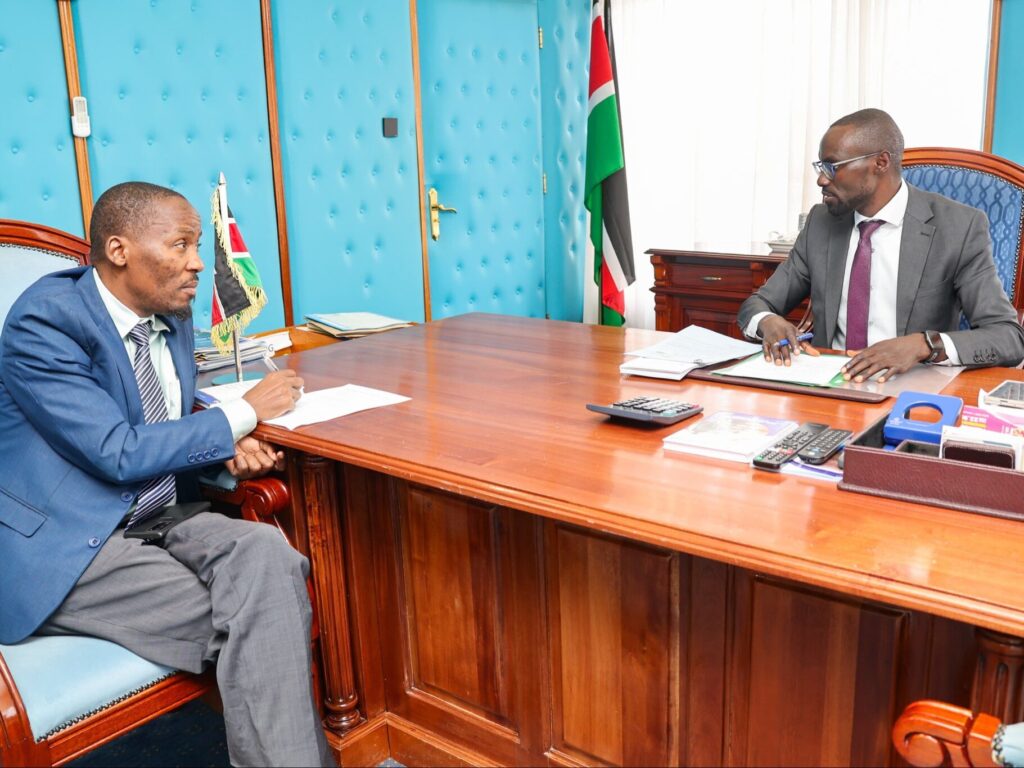
The initiatives were highlighted during a briefing between Cabinet Secretary for Water, Sanitation and Irrigation Eng. Eric Mugaa and the Acting Chief Executive Officer of the Regional Centre on Groundwater Resources Education, Training and Research (RCGW), Geol. Patrick Murunga, who presented updates on the Centre’s ongoing projects and partnerships.
One of the key initiatives is the Groundwater Mapping for the Nairobi Aquifer System (GROWANA), a Danish-Kenyan partnership using airborne electromagnetic technology to generate detailed information about underground geological formations and groundwater potential.
The project uses SkyTEM technology, which involves mounting electromagnetic sensors on a helicopter to collect information about geological structures hundreds of metres beneath the surface. The survey does not require drilling across the entire study area. Instead, the collected data is processed to develop detailed models showing the structure and characteristics of underground formations.
According to the project’s information, the airborne survey was conducted between March 5 and 31, 2026, covering the Nairobi-Kajiado aquifer system. The exercise is part of a two-year programme running from October 2025 to Oectober 2027, bringing together the Geological Survey of Denmark and Greenland, Aarhus University, SkyTEM and RCGW.
The resulting three-dimensional hydrogeological models are expected to improve understanding of groundwater occurrence, identify potential recharge areas and guide the location of future boreholes. The information will also support decisions on groundwater development and protection in the rapidly growing Nairobi metropolitan region.
The mapping comes against the background of growing concerns over pressure on underground water reserves. A 2021 World Bank groundwater governance assessment identified the Nairobi Aquifer System as a strategic resource facing increasing pressure from urban growth and rising abstraction. It also identified areas where intensive pumping had contributed to falling groundwater levels and changes in water quality.
More recently, concerns over excessive borehole drilling in parts of Nairobi have prompted regulatory attention. In May 2026, the Watr Resources Authority undertook a survey of boreholes in Karen and Lang’ata following complaints about declining groundwater levels and concerns over unsustainable extraction. The exercise followed a court directive requiring verification of borehole permits, locations, construction details and abstraction levels.
Another initiative presented to Mugaa was the WATCH project, which is assessing water resources in the Chyulu Hills using muon tomography alongside other scientific methods. The research seeks to improve understanding of how water is stored and moves through the volcanic landscape, which supports springs, local communities, farming activities and ecosystems.
Research presented at the 2026 European Geosciences Union General Assembly described WATCH and its related Time2WATCH initiative as part of efforts to establish a permanent groundwater observatory in the Chyulu Hills. The multidisciplinary programme brings together Kenyan and French research institutions, including RCGW, the University of Nairobi and the Technical University of Kenya.
The Chyulu Hills are an important water source for communities and ecosystems in the semi-arid region. Research presented by the project team identifies Mzima Springs as a major outlet of the Chyulu Hills watershed, accounting for about 70 per cent of its total outflow. Part of the spring’s water is diverted to supply Mombasa, highlighting the importance of understanding the resource and balancing competing water needs.
The Centre is also preparing a Managed Aquifer Recharge (MAR) pilot for the Nairobi Aquifer System. The approach involves directing suitable water into underground geological formations where it can be stored and recovered when needed. Depending on site conditions, recharge can involve appropriately treated stormwater or other suitable water sources.
An expression of interest published by the African Development Bank on February 20, 2026, confirmed that RCGW had received financing through the Government of Kenya and the Ministry of Water, Sanitation and Irrigation to engage a consulting firm for the pilot. The assignment covers the design, construction and development of recharge infrastructure, as well as implementation and testing of suitable pilot schemes.
If successfully implemented and monitored, the initiative could provide additional capacity for storing water underground, particularly during periods when surface water is available. However, its effectiveness will depend on identifying suitable recharge locations, protecting groundwater quality and ensuring that extraction remains within sustainable limits.
Mugaa also highlighted the Centre’s ongoing partnership with the Korea Institute of Geoscience and Mineral Resources (KIGAM), although details of the specific activities and expected outputs were not provided in the briefing.
Established as a state corporation under the Ministry of Water, Sanitation and Irrigation in 2015, RCGW is mandated to undertake groundwater research, assess aquifer systems, support resource conservation and provide technical training. Its work includes hydrogeological surveys, water-quality analysis, groundwater mapping and the identification of recharge areas.
The Centre’s expanding research programme is expected to provide scientific evidence for planning borehole development, managing groundwater abstraction and protecting underground reserves. The findings will be important as Kenya seeks to diversify its water sources and improve the resilience of communities that depend on groundwater.