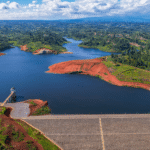
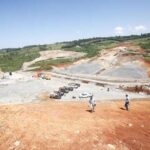

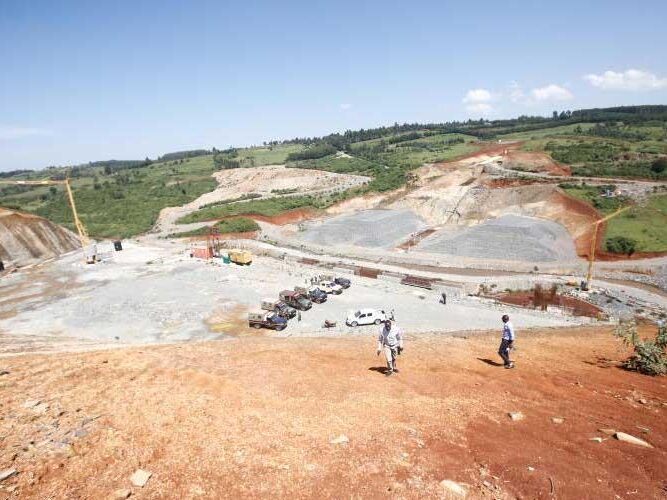
Itare Dam site in Kuresoi South in Nakuru County on September 17, 2019. Photo. [ Kipsang Joseph, Standard]
Kenya requires an additional Sh109.4 billion to complete four stalled multipurpose dam projects, raising fresh questions about the country’s ability to deliver major water infrastructure investments after billions of shillings have already been spent without substantial construction progress.
The projects, Arror, Kimwarer, Itare and Soin-Koru, had absorbed approximately Sh22.6 billion by June 2026 against a combined estimated cost of Sh132 billion, according to government budget disclosures for the 2027/28 financial year. Their completion remains critical to expanding water supply, supporting irrigation, generating electricity and reducing flood risks in vulnerable regions.
The latest assessment shows that none of the four projects had surpassed 27 per cent completion as of June 30, 2026, with Soin-Koru recording the lowest progress at eight per cent. The figures highlight the financial and implementation challenges facing the government as it seeks to revive infrastructure projects that have remained incomplete for years.
Arror Dam in Elgeyo-Marakwet County has an estimated cost of Sh38.5 billion, of which Sh4.978 billion had been spent by June 2026, representing 13 per cent completion. The project was designed to generate approximately 60 megawatts of hydropower, support irrigation across 2,500 hectares and improve water access for about 50,000 households and livestock.
Its sister project, Kimwarer Dam, also in Elgeyo-Marakwet County, had absorbed Sh3.886 billion against an estimated cost of Sh33.5 billion, representing 12 per cent completion. The two projects were conceived to strengthen water storage, agricultural production and electricity generation in the Rift Valley region, but their implementation was disrupted by procurement controversies, financing questions and investigations into their contractual arrangements.
Kimwarer encountered additional technical and financial concerns after a government-appointed team reportedly questioned the viability of the project in its proposed form. The government has since indicated that negotiations to revive both Arror and Kimwarer are ongoing, although the latest funding requirements underline the scale of investment still needed to complete them.
Itare Dam in Nakuru County has absorbed the largest amount of money among the four projects, with expenditure reaching Sh12.066 billion against an estimated cost of Sh35 billion. Despite accounting for more than half of the combined expenditure, the project had attained only 27 per cent completion by June 2026, leaving approximately Sh22.934 billion required under the latest government assessment.
The dam was designed to store approximately 27 million cubic metres of water and supply up to 100 million litres of treated water daily to Nakuru City and surrounding communities. Once completed, it is expected to strengthen domestic and industrial water supply in an area facing growing demand for reliable water services.
Construction was undertaken by Italian firm CMC di Ravenna but stalled in September 2018 following contractual and financing disagreements. Although the project’s original estimated cost was Sh35 billion, the government indicated in 2024 that revival could push the cost to approximately Sh40 billion. The latest June 2026 budget assessment, however, retains the Sh35 billion estimate.
The government has pursued negotiations with Italian authorities and the contractor to resolve the outstanding disputes and establish a framework for resuming construction. During President William Ruto’s April 2026 visit to Italy, discussions with Prime Minister Giorgia Meloni reportedly made progress towards resolving the contractual disagreements, including issues surrounding arbitration proceedings. However, the outstanding financing requirement means that reaching an agreement must be followed by securing funds and restoring construction activities.
Soin-Koru Multipurpose Dam, which straddles Kisumu and Kericho counties along the Nyando River, faces a different set of implementation challenges, with inadequate budgetary allocations cited as a major reason for the construction slowdown.
The project had absorbed approximately Sh1.67 billion against an estimated cost of Sh25 billion by June 2026, representing just eight per cent completion and leaving an additional Sh23.33 billion required.
Designed to store approximately 93.7 million cubic metres of water, Soin-Koru is expected to supply 72,000 cubic metres daily, support irrigation across 2,570 hectares and generate 2.5 megawatts of electricity. It is also intended to reduce recurrent flooding in the Nyando River Basin, where communities have experienced repeated losses associated with overflowing river waters.
The construction contract was awarded to China Jiangxi International Kenya Limited in May 2022 at approximately Sh19.99 billion, with construction commencing in August of the same year. However, an Auditor-General’s inspection raised concerns over the contractor’s absence from the site and delays in undertaking key construction activities. The State Department for Irrigation attributed the suspension to inadequate budgetary allocation.
The government has explored alternative financing arrangements for the project, including the proposed Infrastructure Development Fund and possible private-sector participation. In December 2025, Deputy Chief of Staff Eliud Owalo proposed using the fund to accelerate construction, warning that annual allocations of approximately Sh1 billion could prolong completion by nearly two decades.
The financial burden associated with the four projects extends beyond their outstanding construction costs. An Auditor-General’s report for the 2023/24 financial year also raised concerns over the restructuring of loans linked to Arror, Kimwarer and Itare, identifying an outstanding restructured balance of approximately Sh31.475 billion, equivalent to €226.66 million, as of June 2024.
The audit noted that the Treasury had not provided the restructuring agreements and supporting documentation required to verify the outstanding loan balance and establish whether the projects had delivered value for money. The report consequently indicated that the authenticity of the balance and value for money could not be confirmed.
The loan balance relates to the three Italian-linked projects and represents a separate financial consideration from the Sh109.4 billion required to complete all four dams. The two figures should not be treated as interchangeable or added together without accounting for possible overlaps in the underlying obligations.
The delays have also postponed the water security and economic benefits expected from the investments. In Nakuru, the incomplete Itare project means communities and businesses are yet to receive the additional water supplies planned under the scheme. In Elgeyo-Marakwet, the stalled Arror and Kimwarer projects have delayed the anticipated expansion of irrigation and hydropower generation, while communities downstream of the Nyando River remain without the planned flood management benefits of Soin-Koru.
The four projects were initiated under different implementation timelines, although Arror, Kimwarer and Itare are associated with the infrastructure programme pursued during former President Uhuru Kenyatta’s administration. Soin-Koru’s construction contract was awarded in 2022, with physical implementation commencing in August of that year.
The additional Sh109.4 billion requirement now places renewed pressure on government financing plans, particularly as the country continues to demand investment in water supply, sanitation, irrigation and climate-resilient infrastructure. Beyond securing the money, the government must address the contractual and implementation challenges that contributed to the delays and ensure that future allocations translate into measurable construction progress.
With Sh22.6 billion already spent and the four dams still far from completion, the central challenge is no longer simply delivering new infrastructure but ensuring that public investment produces the promised water, agricultural, energy and flood-control benefits. The success of the proposed revival plans will ultimately depend on securing sustainable financing, resolving outstanding disputes and establishing clear implementation timelines for each project.