









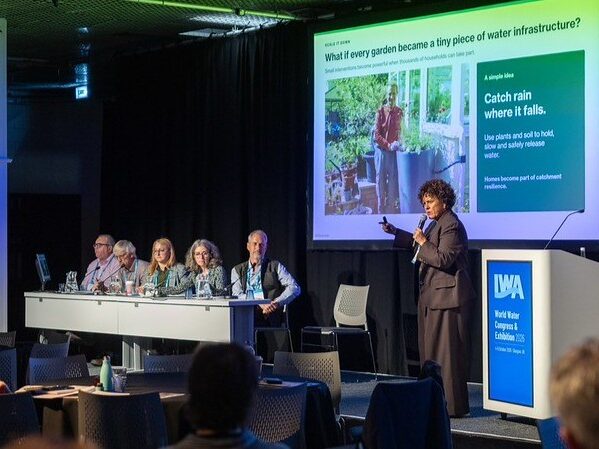
Water utilities across the world are increasingly turning to technology, international cooperation and climate-resilient infrastructure to address growing pressure on water supplies, ageing distribution networks and changing weather patterns.
The need for stronger collaboration emerged during the International Water Association (IWA) World Water Congress and Exhibition held in Glasgow, Scotland, from October 4 to 8, 2026, which brought together more than 8,500 delegates, exhibitors and visitors from across the global water sector.
The five-day conference provided a platform for water companies, researchers, policymakers, regulators and technology providers to exchange experiences and explore practical solutions to challenges affecting water and sanitation services.
Organised under the theme ‘Water Action – The Path to Resilience and Prosperity’, the congress focused on strengthening water systems through innovation, improved utility management, wastewater treatment, resource recovery and sustainable water-resource management.
The discussions reflected growing recognition that challenges facing water utilities are no longer confined to individual countries, with climate change, population growth, infrastructure deterioration and increasing demand placing pressure on water systems across different regions.
United Utilities, one of the UK’s major water and wastewater companies, said the event provided an opportunity to share expertise, strengthen partnerships and learn from international experiences that could influence future approaches to water management.
“Managing water for healthy, resilient societies is one of the greatest global challenges, so it was inspiring to see water professionals from around the world coming together to share experiences and innovations,” said Andrew Ward, Corporate Affairs Director at United Utilities.
The company said it had been selected to lead six events during the congress, covering areas including nature resilience, standardisation and collaboration across the water sector.
Its participation included leadership of the Nature Resilience Forum, a workshop on its Blueprints for Tomorrow Standardisation initiative, contributions to the UK Pavilion and involvement in discussions on the future of water services.
The UK Pavilion also provided a platform for water companies, suppliers and international delegates to exchange ideas and explore opportunities for cooperation.
Joel Armstrong, Strategy Development Manager at United Utilities, said the pavilion helped bring together organisations from across the sector to share experiences and demonstrate the expertise available within the UK water industry.
“It was a brilliant experience being involved in the UK Pavilion at the World Water Congress in Glasgow, bringing together water companies and the wider supply chain to share perspectives, exchange ideas and learn from experiences across our sector,” Armstrong said.
A major highlight of the congress was the recognition of utilities making progress in climate adaptation, emissions reduction and sustainable water services.
Through the International Water Association’s 2026 Climate Smart Utilities Recognition Programme, 41 water and sanitation utilities were recognised for their progress towards climate-resilient operations.
The programme received 152 applications from utilities across 78 countries, with seven organisations achieving the highest Outstanding recognition.
United Utilities was among the seven recognised organisations, highlighting its work in climate resilience, innovation and sustainable water services.
The programme assessed utility performance across three main areas: climate adaptation, mitigation and leadership.
These areas reflect the growing need for water companies to prepare for extreme weather events, reduce emissions associated with water and wastewater operations and incorporate climate considerations into long-term investment decisions.
Beyond climate resilience, the congress also examined technologies and approaches that could improve the efficiency and sustainability of water services.
Discussions covered water reuse, desalination, digital innovation, wildfire resilience and the protection of natural environments.
Water reuse is increasingly attracting attention as utilities seek to reduce pressure on conventional freshwater sources by treating wastewater for appropriate applications.
Desalination is also becoming an important alternative in water-stressed regions, although its wider adoption depends on energy costs, infrastructure investment and environmental considerations.
Digital technologies, including artificial intelligence, remote monitoring and Internet of Things systems, are creating opportunities for utilities to improve operational efficiency, monitor infrastructure and identify problems within distribution networks.
The IWA programme featured more than 100 technical sessions and over 60 workshops, while the exhibition brought together approximately 350 global brands showcasing water-sector technologies and services.
The congress also included discussions on wastewater surveillance, water-quality monitoring, nature-based solutions, resource recovery and the development of low-carbon water services.
These discussions are particularly relevant to developing countries, where expanding access to safe water must be accompanied by investments in reliable infrastructure, efficient distribution systems and sustainable wastewater management.
For Kenya, the lessons from Glasgow are relevant as water utilities continue to face challenges involving non-revenue water, inadequate infrastructure, growing urban demand and limited financial resources for system expansion.
The country has been pursuing investments in water treatment plants, transmission pipelines, reservoirs and sewerage infrastructure to improve service delivery and expand access to safe water.
However, the performance of these investments also depends on the ability of utilities to manage existing infrastructure efficiently, reduce physical water losses, improve billing systems and maintain reliable supplies.
Kenya’s national non-revenue water level has been estimated at approximately 48 per cent, meaning that a substantial share of treated water does not generate revenue for utilities because of physical losses, commercial losses and other inefficiencies.
The international discussions on digital monitoring, climate-smart utility management and infrastructure resilience offer potential lessons for improving the performance of local water companies.
Technology could help Kenyan utilities identify leaks, monitor water flows, improve pressure management and strengthen the collection of operational data needed for investment planning.
The congress also highlighted the importance of protecting natural water sources and integrating environmental considerations into infrastructure development.
For water-stressed countries, this means combining investment in dams, reservoirs and treatment facilities with catchment protection, groundwater management, wastewater recycling and conservation measures.
The event’s Utility Leaders Forum provided an additional platform for discussing how water companies can strengthen institutional leadership, improve partnerships and prepare for long-term changes in water demand and climate conditions.
As the congress concluded, attention shifted towards translating the discussions and technical knowledge into practical improvements within water organisations.
IWA President Hamanth Kasan urged participants to sustain the cooperation established during the event, encouraging the global water community to continue working towards equitable access to safe water and sanitation.
The next IWA World Water Congress and Exhibition is scheduled to take place in Kuching, Sarawak, Malaysia, in 2028.
The Glasgow meeting reinforced the importance of international knowledge exchange in addressing water challenges, with utilities increasingly expected to move beyond discussions and demonstrate measurable improvements in service reliability, environmental protection and climate resilience.