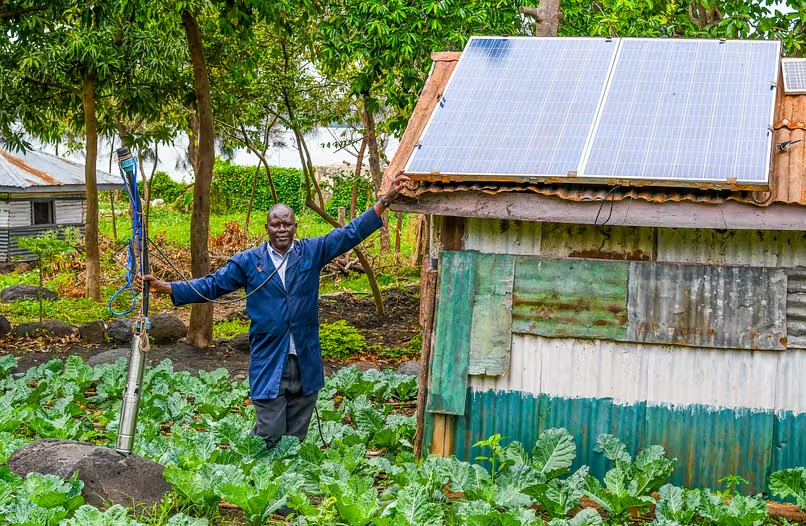
Maurice Owino, a smallholder farmer in Siaya County, Kenya, in his land. His solar-powered irrigation pump has boosted yields and increased resilience to drought. Photo: SunCulture
Solar-powered irrigation is emerging as an important tool for transforming smallholder agriculture in Ethiopia, where farmers are using renewable energy to improve food production, reduce operating costs and increase household incomes. The experience is offering lessons for other African countries, including Kenya, where unreliable rainfall, expensive irrigation and limited access to affordable farming technologies continue to constrain agricultural productivity.
In Ethiopia’s Central and Sidama regions, solar irrigation is helping farmers access water more reliably, grow crops throughout the year and produce surpluses for sale in local markets. The technology is also improving household food and nutrition security, with additional income enabling some farming families to invest in their children’s education.
The International Water Management Institute (IWMI), working with development partners, is promoting an approach that goes beyond distributing solar-powered pumps. The model combines access to financing, technical training, improved agricultural practices and partnerships to help farmers maximise the benefits of irrigation.
The experience is particularly relevant to Kenya, where the government is seeking to expand irrigated agriculture as part of efforts to strengthen food security, increase agricultural incomes and reduce dependence on rain-fed farming.
Under the National Irrigation Sector Investment Plan (NISIP) 2025–2035, Kenya aims to expand irrigated land to 1.5 million acres by 2030, against an estimated irrigation potential of approximately 3.5 million acres. The strategy identifies farmer-led irrigation development as one of the important pathways for increasing agricultural production by enabling individual farmers and groups to invest in irrigation technologies suited to their needs.
Solar-powered pumps could play a significant role in achieving these ambitions, particularly among smallholder farmers in areas where electricity infrastructure is limited or expensive to extend. By using sunlight to power water pumps, farmers can reduce their dependence on diesel and electricity while lowering recurring irrigation expenses.
Kenya already has an emerging solar irrigation industry, with companies such as SunCulture Kenya and FuturePump providing solar-powered pumping technologies and related agricultural solutions. These businesses offer opportunities to expand access to irrigation equipment, although the initial cost remains a barrier for many small-scale farmers.
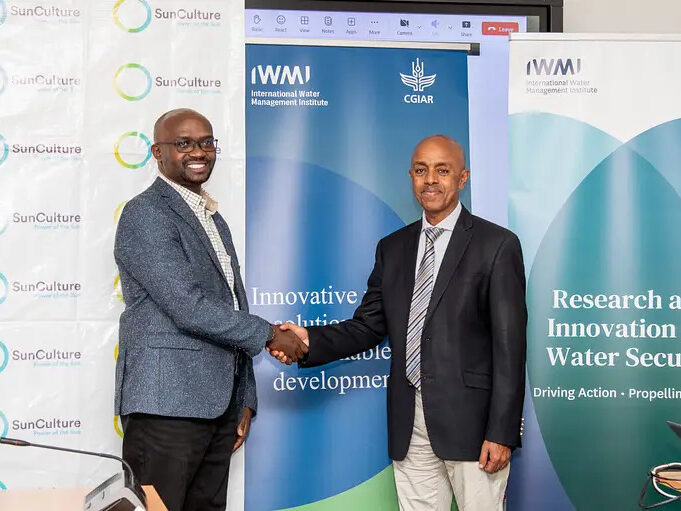
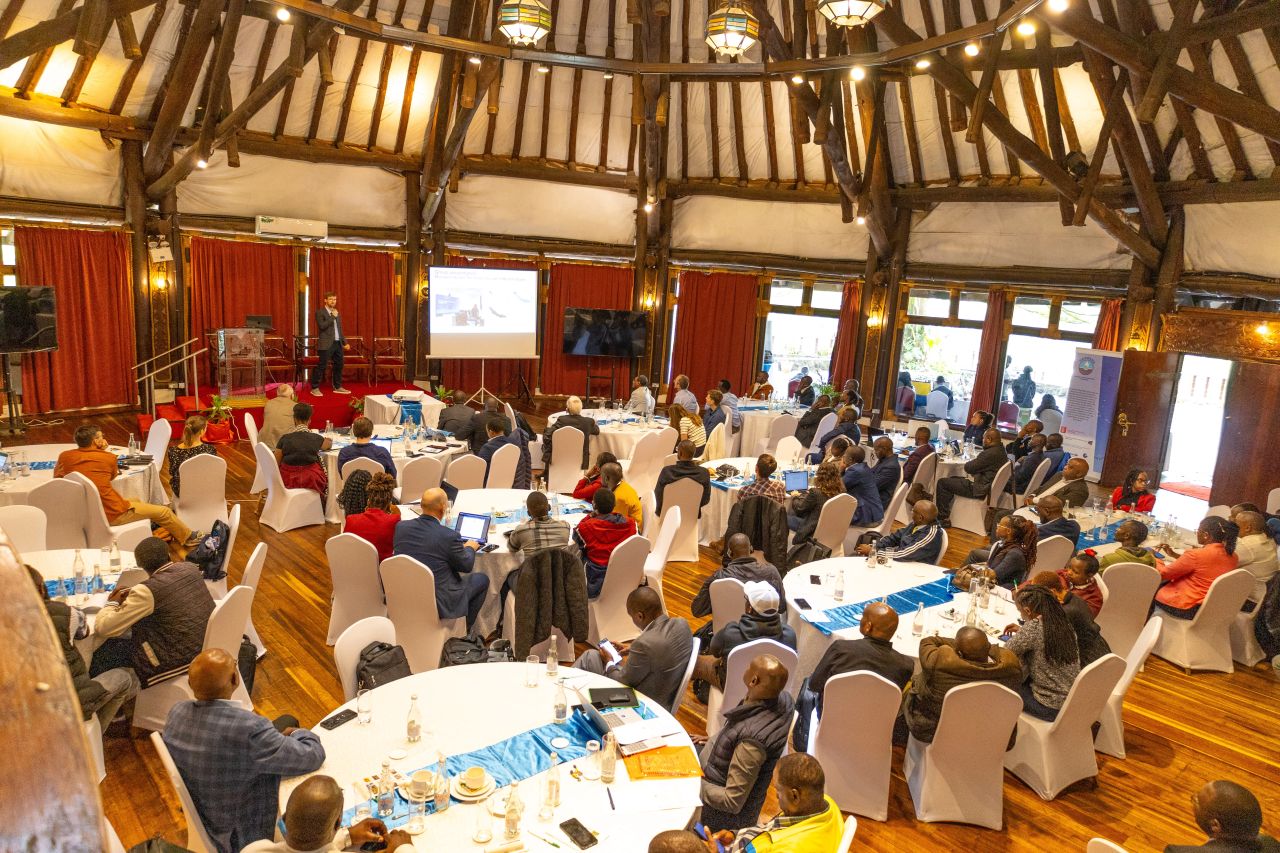
Patrick Mengo (left), SunCulture General Manager for Kenya, and Abdulkarim Seid, IWMI Regional Representative for East Africa, shake hands during the launch of the partnership in Nairobi. Photo: SunCulture
Recognising this potential, IWMI has included Kenya in the second phase of its Solar Energy for Agricultural Resilience (SoLAR) project, which runs from July 2025 to December 2028 with support from the Swiss Agency for Development and Cooperation.
The initiative is working with the National Irrigation Authority (NIA), the Rural Electrification and Renewable Energy Corporation (REREC) and private-sector partners to develop models that can make solar irrigation more accessible and economically sustainable.
Its activities in Kenya include testing inclusive financing arrangements, conducting feasibility and impact studies, and building the capacity of agricultural extension workers and community trainers. Pilot interventions are also exploring how solar pumps can be combined with other technologies, including solar dryers and cold storage, to help farmers preserve produce, reduce post-harvest losses and increase earnings.
This approach could be particularly useful in Kenya’s smallholder farming areas, where access to irrigation alone does not always guarantee higher incomes. Farmers also need reliable markets, affordable seeds and fertiliser, appropriate farming skills and facilities to store or process their produce.
Financing will be one of the most important considerations in expanding the technology. Many farmers cannot afford the upfront cost of solar pumping equipment, even where the long-term savings could make the investment worthwhile. Kenya could therefore expand cost-sharing arrangements, affordable credit, pay-as-you-grow financing and partnerships between government, financial institutions and private equipment suppliers.
The government has already been exploring ways to attract private investment into farmer-led irrigation development. In February 2026, the State Department for Irrigation outlined plans to work with private-sector players to expand access to affordable irrigation technologies, including solar pumps and drip irrigation kits.
The proposed expansion also requires stronger technical support. Farmers need training on operating and maintaining solar equipment, selecting appropriate irrigation systems and applying efficient water-use practices. Local technicians should also be trained to provide repairs and maintenance, reducing the risk of equipment becoming unusable when faults develop.
Water availability must remain central to the expansion. Although solar pumps can reduce energy costs, they do not automatically guarantee sustainable water use. Uncontrolled abstraction from rivers and underground reserves could place additional pressure on already stressed water sources, particularly in arid and semi-arid counties.
The Water Resources Authority should therefore work with irrigation agencies, county governments and farmer organisations to ensure that solar irrigation development is supported by proper water assessments, abstraction permits, monitoring and efficient irrigation technologies such as drip systems.
Kenya could also prioritise solar irrigation in suitable areas where farmers have access to reliable water sources, including community irrigation schemes, smallholder farms and agricultural clusters. Linking these investments with water harvesting and storage infrastructure would help farmers maintain production during periods of low rainfall.
The Ethiopian experience demonstrates that solar irrigation can deliver benefits beyond replacing conventional water pumps. When combined with financing, agricultural training, efficient water management and access to markets, the technology can improve household incomes, strengthen food security and create opportunities for rural communities.
For Kenya, the opportunity lies in adapting this integrated approach to local farming conditions and ensuring that smallholder farmers are not left behind as the country expands its irrigation infrastructure.