


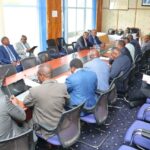

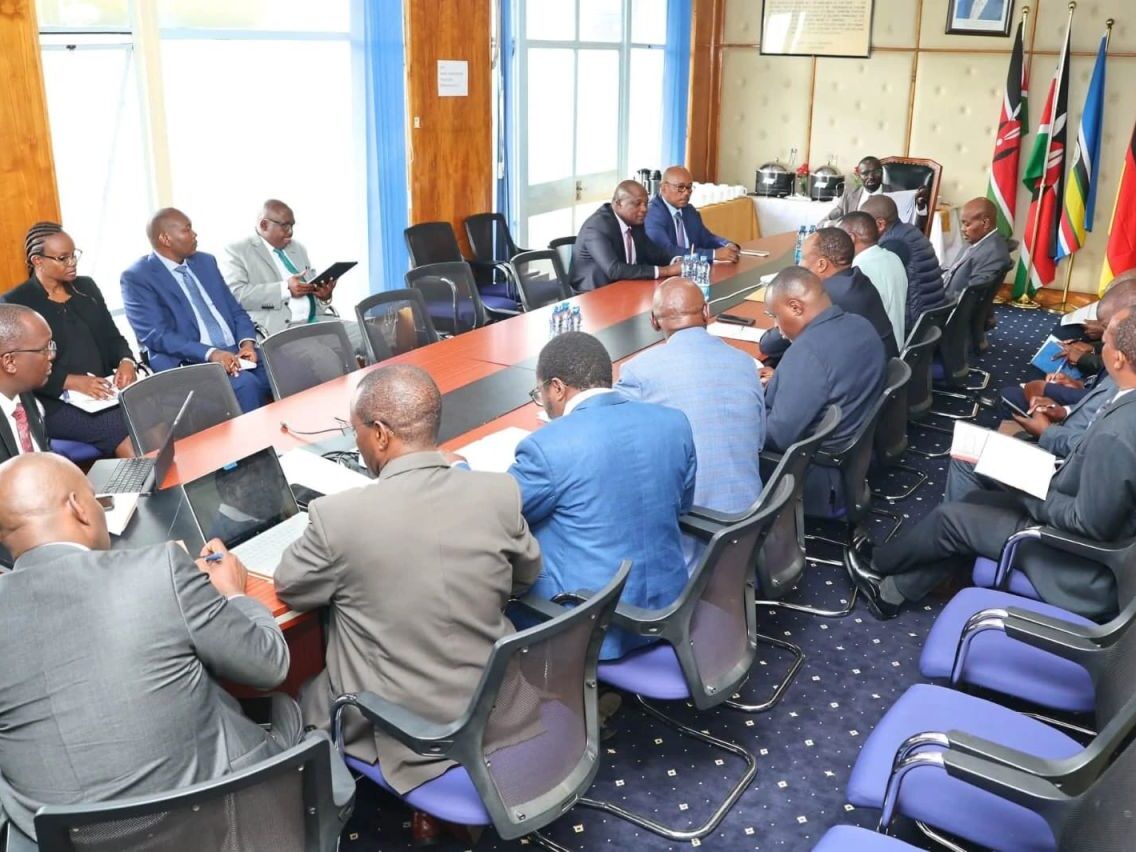
The Ministry of Water, Sanitation and Irrigation has held consultations with Members of Parliament from Meru County to review ongoing water and irrigation projects and discuss new interventions aimed at improving access to reliable water supplies, sanitation services and agricultural production.
The meeting brought together the Cabinet Secretary for Water, Sanitation and Irrigation, the Principal Secretary for Water and Sanitation, the Secretary Administration in the State Department for Irrigation, the Water Services Regulatory Board (WASREB) Chief Executive Officer Mr Leparan Tialal and other water sector chief executives.
The parliamentary delegation was led by Imenti Central MP Kirima Nguchine and included Igembe Central MP Daniel Kiili and Igembe North MP Julius Taitumu.
Discussions focused on the status of water and irrigation infrastructure projects across Meru County, with the leaders reviewing implementation progress, identifying challenges affecting delivery and considering additional investments required to address the region’s water needs.
The engagement provided an opportunity for the legislators to raise concerns affecting their constituencies and seek government intervention in accelerating projects intended to improve household water access, strengthen sanitation infrastructure and expand irrigation opportunities for farmers.
Water availability remains an important development priority in Meru, where communities depend on a combination of rivers, springs, boreholes and public water supply schemes. Although the county has considerable water resources, access to reliable and safely managed supplies varies across different areas, particularly in communities located far from established distribution networks.
The need to expand water infrastructure is also linked to the county’s agricultural economy. Meru is one of Kenya’s important agricultural regions, with farming activities ranging from food crop production to horticulture, dairy farming and other commercial agricultural enterprises. Reliable water supplies are therefore essential not only for household consumption but also for livestock production and agricultural productivity.
Expanding irrigation infrastructure could help farmers reduce their dependence on rainfall, improve production during dry periods and support more consistent agricultural output. Irrigation development is particularly important as changing rainfall patterns and prolonged dry spells increasingly affect farming activities in different parts of the country.
The discussions also highlighted the importance of improving sanitation services alongside water supply investments. Expanding access to clean water must be supported by appropriate sanitation infrastructure, wastewater management and environmental protection measures to safeguard public health and prevent pollution of rivers and other water sources.
WASREB’s participation in the meeting was significant because of its regulatory responsibility in the water services sector. The regulator oversees water service providers, monitors service delivery standards and protects consumers’ interests through licensing, performance monitoring and regulation of water tariffs.
Its involvement provides an opportunity to align infrastructure expansion with service delivery requirements, ensuring that new water projects are supported by effective management and sustainable operational arrangements.
The meeting also underscored the importance of coordination between national government institutions, elected representatives, water agencies and other implementing bodies. Such engagement helps identify local priorities, address implementation bottlenecks and improve accountability in the delivery of publicly funded infrastructure projects.
The Ministry reaffirmed its commitment to working closely with elected leaders and other stakeholders to accelerate the implementation of ongoing projects and advance planned interventions across Meru County.
The collaboration is expected to strengthen efforts to expand water supply coverage, improve sanitation and develop irrigation infrastructure that supports agricultural growth and community livelihoods.
As Kenya continues to pursue universal access to safe water and sanitation while expanding irrigated agriculture, coordination between national institutions and county-level representatives remains essential in ensuring that infrastructure investments respond to the needs of communities.
The engagement with Meru legislators forms part of broader efforts to strengthen cooperation between the Ministry and elected leaders in addressing water and irrigation development priorities.