








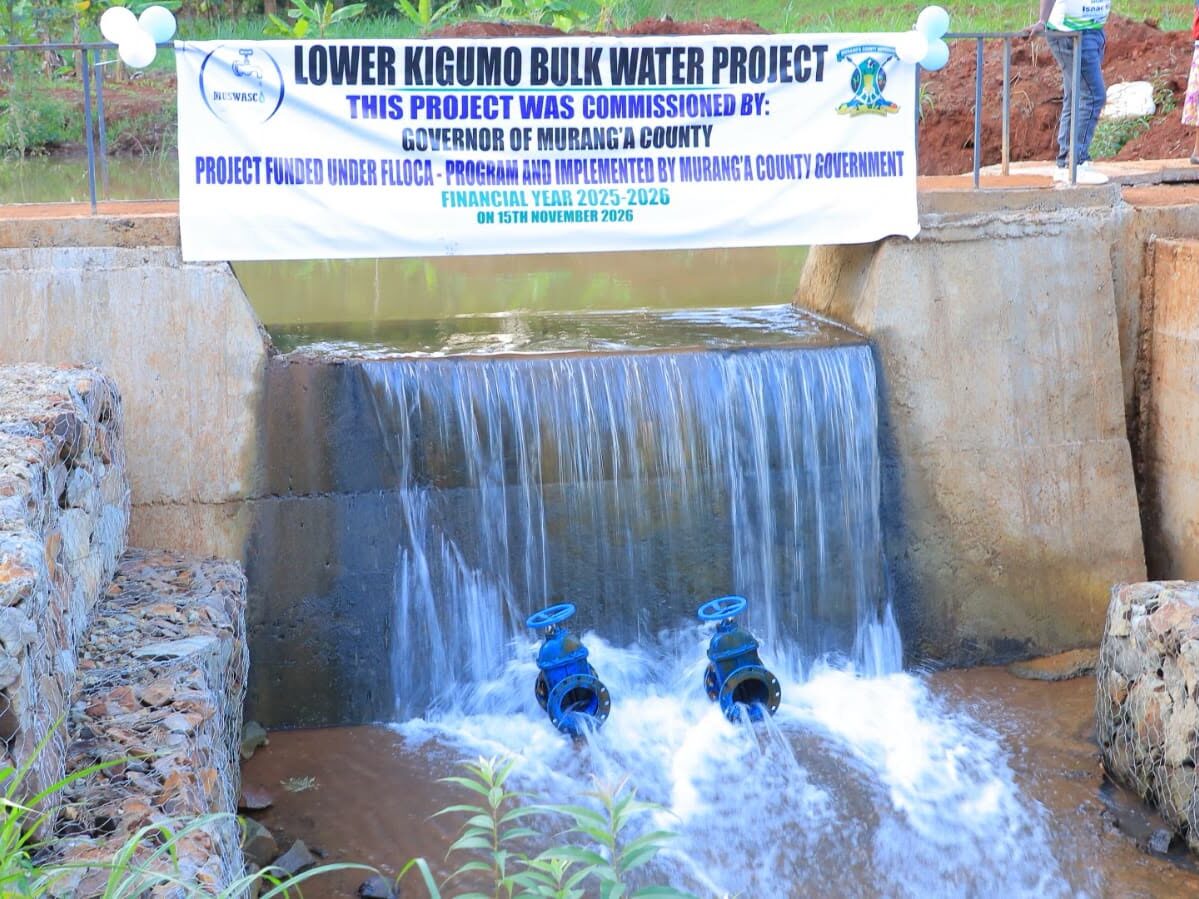
Murang’a County Government has commissioned a new water intake facility at the Lower Kigumo Bulk Water Project in Muthithi Ward, in a move expected to increase daily water production by one million litres and improve access to reliable supplies for households, institutions and businesses.
The project is part of the county’s efforts to strengthen water infrastructure, expand distribution capacity and address growing demand for clean water among residents. The additional production is expected to ease pressure on existing water supply systems while improving the availability of water in areas served by the project.
The new intake facility is an important component of bulk water infrastructure because it provides the starting point for collecting and conveying raw water for treatment and eventual distribution to consumers. Its commissioning is therefore expected to strengthen the capacity of the wider water supply system to serve communities more consistently.
The commissioning comes at a time when Murang’a is seeking to close gaps in water access, particularly in areas where population growth and expanding settlements have increased demand beyond the capacity of existing infrastructure.
The county has been investing in additional water sources, pipeline extensions and improvements to existing supply systems to reach more households. Its Water Connectivity Programme includes drilling boreholes and extending distribution networks to underserved communities, with a longer-term target of achieving universal water coverage by 2027.
The importance of increasing bulk water production is also reflected in the county’s existing supply challenges. County reports have indicated that water production and distribution remain under pressure as more households are connected to public water systems.
The county has continued to expand water distribution networks, but the growing number of connections has exposed the need for additional production capacity to ensure that consumers receive adequate supplies.
Beyond domestic consumption, the Lower Kigumo project is also expected to support agricultural activities, particularly irrigation, which is important in a county where farming remains a major source of livelihoods. Improved water availability can help farmers reduce dependence on rainfall and support more reliable agricultural production.
The project also reflects a wider shift towards developing bulk water infrastructure to address shortages rather than relying solely on extending pipelines. While distribution networks are essential in connecting households, their effectiveness depends on having sufficient water available at the source.
However, the additional production will need to be supported by adequate treatment capacity, storage facilities and distribution networks to ensure that the increased supply reaches intended consumers. Proper maintenance of the intake infrastructure and protection of its water source will also be important in sustaining production.
Murang’a’s investment in the Lower Kigumo facility therefore represents another step towards strengthening water security, supporting local economic activities and improving access to reliable water services. Its long-term impact will depend on how effectively the additional capacity is integrated into the county’s wider water supply network.