
Water regulators have been challenged to strengthen accountability, improve service delivery and adopt climate-resilient regulatory systems as the sector faces growing pressure to provide reliable, affordable and sustainable water and sanitation services.
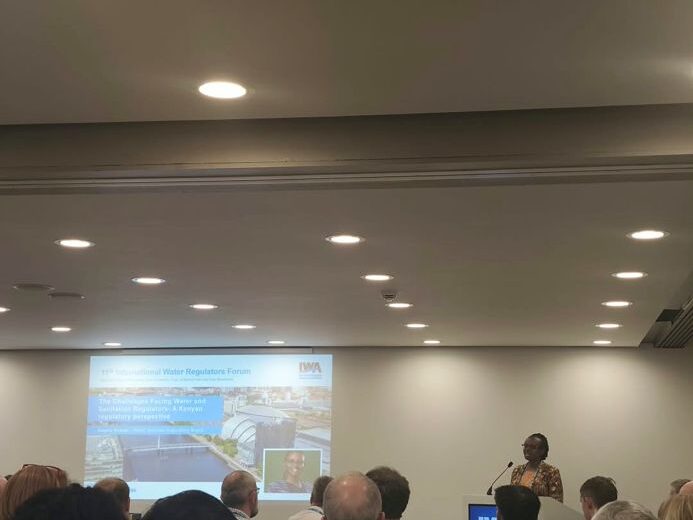
The call emerged during the 11th International Water Regulators Forum (IWRF), held alongside the International Water Association (IWA) World Water Congress and Exhibition 2026 in Glasgow, Scotland. The forum brought together regulators, policymakers, researchers and development partners to examine emerging challenges under the theme “WASH Regulation Under Uncertainty: Trust, Judgement and Long-Term Stewardship.”
Kenya’s experience featured in discussions on the challenges facing water and sanitation regulators, with the Water Services Regulatory Board (WASREB) represented by Deputy Director of Corporate Planning Angela Kimani.
In her presentation, “The Challenges Facing Water and Sanitation Regulators: A Kenyan Regulatory Perspective,” Kimani highlighted the difficulties regulators face in ensuring equitable, efficient and sustainable water services amid changing operational, financial and environmental conditions.
Her presentation addressed accountability and governance, regulatory resilience, sector performance, affordability and institutional maturity. These issues reflect the need for regulatory institutions to strengthen oversight while helping water service providers remain financially viable and responsive to consumers.
Kenya’s experience underscored the importance of reliable sector data, stronger institutional governance, modern regulatory tools and frameworks that respond to climate risks. Collaboration among regulators, water utilities, government institutions and other stakeholders was also identified as essential to improving performance.
Strengthening the legal framework and improving the operational efficiency of water utilities remain important priorities. Regulators must also balance affordable tariffs for consumers with the revenue required to maintain infrastructure, expand services and ensure long-term financial sustainability.
The discussions also highlighted the need to extend effective regulation beyond conventional piped water networks to include rural water supply systems and on-site sanitation. These services are particularly important in areas where households depend on community-managed schemes and alternative sanitation solutions.
Participants exchanged experiences on how countries can progressively strengthen oversight of these services while adapting regulatory approaches to different local conditions.
WASREB also participated in the Glasgow High-Level Summit on Water for People, which focused on translating international water commitments into practical improvements for communities. The summit examined barriers to inclusive service delivery, institutional and workforce capacity, and financing for sustainable water services.
A central message from the summit was that investment should go beyond constructing water infrastructure to ensure that systems remain functional, affordable and reliable over time. This requires adequate financing, skilled personnel and institutions capable of maintaining services while responding to changing community needs.
The discussions come as the global community prepares for the 2026 United Nations Water Conference, scheduled for December 8–10 in Abu Dhabi, United Arab Emirates. The conference aims to accelerate progress towards Sustainable Development Goal 6, which seeks to ensure the availability and sustainable management of water and sanitation for all.
In Kenya, WASREB regulates water services under the Water Act, 2016, with responsibilities that include protecting consumer interests, overseeing water service providers and monitoring performance against established standards. Its performance assessments cover indicators such as water and sanitation coverage, water quality, supply hours, revenue collection and operational cost recovery.
The international discussions reinforced the importance of regulation that protects consumers while supporting financially sustainable utilities, strengthens institutional accountability and ensures that underserved communities are not left behind.