
Integrated water sources strengthen rural resilience
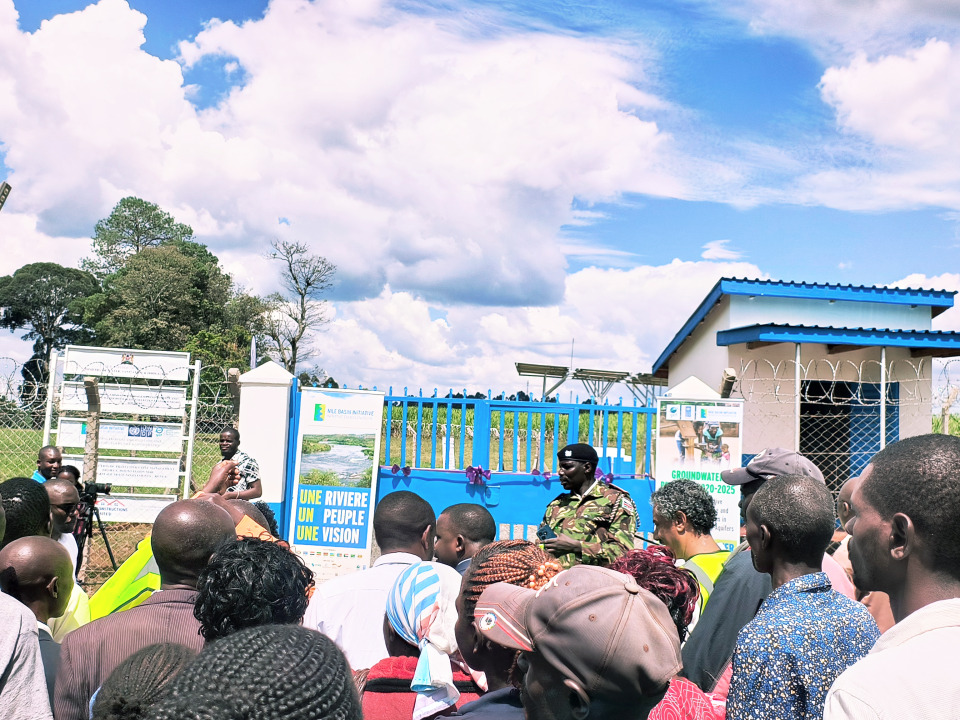
A pilot water project in Lukesi Ward, Saboti Sub-County, Trans Nzoia County has demonstrated the potential of combining groundwater and surface-water sources to strengthen the resilience of rural water supply systems, while also highlighting the importance of careful water-quality assessment before different sources are blended.
The project is being implemented by the Government of Kenya through the Ministry of Water, Sanitation and Irrigation in collaboration with the Nile Basin Initiative Secretariat. It is funded by the Global Environment Facility (GEF) through UNDP Uganda.
The pilot was designed to test Managed Aquifer Recharge (MAR), conjunctive use and rural water supply. Although it did not successfully demonstrate managed aquifer recharge, the project proved the feasibility of conjunctive use between groundwater and surface-water sources.
The initial design proposed abstracting groundwater from the project’s production borehole and blending it with groundwater from an existing school borehole. The system was also to be complemented by rainwater harvesting at Bishop Crawley Secondary School.
The final configuration demonstrated how groundwater, rainwater harvesting, storage infrastructure, solar pumping and community water points can be integrated and managed as a single rural water-supply system.
However, implementation also provided an important water-safety lesson regarding the blending of water from different sources. Water from Bishop Crawley Secondary School was found to be brackish, while water from the project production borehole was fairly soft, with minor elevations in nitrates and manganese.
The project established that automatically mixing the two sources could result in unpredictable salinity and chemical characteristics. Such changes could affect the water’s palatability, treatment performance, corrosion or scaling, as well as compliance with applicable drinking-water requirements.
As a result, any proposed blending of water sources must first be assessed and formally approved before the blended water is used.
The experience also points to the need for comprehensive assessments in similar future projects. Proposed blending should be preceded by hydrogeological assessment, sanitary inspection, representative water-quality testing and hydraulic review, alongside confirmation that appropriate treatment and monitoring arrangements are in place.
Source segregation should also be maintained until the responsible authority confirms that blending is technically and publicly safe.
Beyond water quality, the Lukesi project reinforced the importance of effective infrastructure management after construction. Infrastructure handover, the project established, should be accompanied by a practical operation and maintenance plan, an asset register, a maintenance schedule and clear escalation pathways.
Reliable records are equally important to effective operation and maintenance. Daily readings, water-quality results, piezometer data, maintenance records and work orders provide evidence that can support informed management decisions.
The experience from Lukesi therefore points to a broader lesson on sustaining rural water infrastructure. Resilience depends not only on sound construction, but also on disciplined operation, protection of water sources, accurate monitoring, accountable institutions and continuous learning from field experience.
The pilot consequently provides practical lessons for future efforts to develop integrated and resilient water-supply systems that combine different water sources and infrastructure approaches to improve rural water security.