







Kenya is expanding the use of blended financing to accelerate water infrastructure development, with a new partnership involving the Water Sector Trust Fund (WaterFund), Consolidated Bank and Murang’a County targeting improved access to reliable water services in Kiharu.
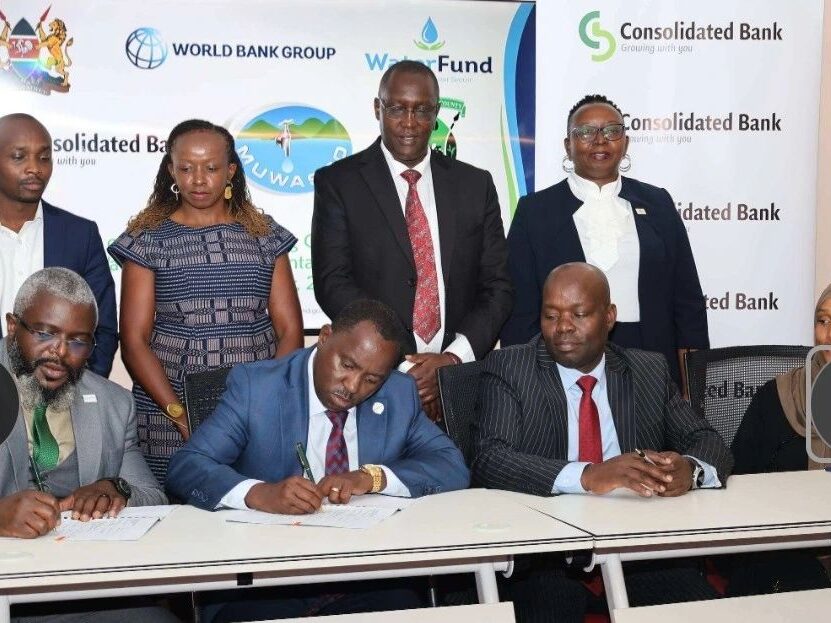
The financing arrangement was formalised through the signing of the Kiharu Water Project Implementation Contract, bringing together WaterFund, the County Government of Murang’a, Murang’a Water and Sanitation Company (MUWASCO) and Consolidated Bank.
Water Services Regulatory Board (WASREB) Chief Executive Officer Leparan C. Tialal attended the signing ceremony, which also featured a K-WASH Operating Contract between WaterFund and Consolidated Bank to establish a framework for financing eligible water infrastructure investments.
Under the arrangement, WaterFund will provide interest-free, returnable matching funds equivalent to 50 per cent of the approved project cost, with the remaining amount supported through complementary financing.
The model introduces an alternative approach to financing water projects by combining public resources with commercial banking participation, potentially allowing water utilities and county governments to implement infrastructure investments without relying entirely on government budget allocations or conventional borrowing.
Unlike a conventional grant, the returnable matching funds are structured to be repaid, allowing the financing mechanism to support eligible investments while retaining resources for future water projects.
The participation of Consolidated Bank is particularly important because access to commercial financing has remained a challenge for many water service providers, which often struggle with limited revenue, high operating costs and inadequate financial capacity to borrow for infrastructure expansion.
Through the K-WASH Operating Contract, WaterFund and the bank are establishing an institutional framework through which eligible water infrastructure investments can access financing under agreed programme arrangements.
The initiative forms part of the broader Kenya Water, Sanitation and Hygiene (K-WASH) Programme, a World Bank-supported government initiative designed to expand sustainable water and sanitation services while improving the operational and financial performance of water service providers.
K-WASH covers 19 counties, including Murang’a, and targets approximately four million beneficiaries, including communities hosting refugees.
The programme supports rural water infrastructure, improved sanitation, institutional strengthening and reforms aimed at making water service providers more financially sustainable.
Its financing structure combines World Bank support, government counterpart funding and commercial financing mobilised through participating water service providers.
According to programme documentation, the main Performance for Results component amounts to approximately US$438 million, comprising US$230 million in International Development Association financing, US$200 million in government counterpart funding and US$8 million expected from commercial financing by participating water service providers.
A further US$20 million supports institutional capacity, programme management, governance and accountability.
The Kiharu arrangement therefore provides an example of how financial institutions can participate in the wider effort to close Kenya’s water infrastructure investment gap.
The National Water and Sanitation Investment and Financing Plan estimates that the country requires approximately KSh995 billion between 2023 and 2030 to meet its water and sanitation development ambitions, leaving a financing gap of approximately KSh652 billion.
The funding requirement covers new water sources, treatment facilities, transmission infrastructure, distribution networks, sewerage systems and household connections.
Mobilising commercial financing alongside public resources is consequently becoming increasingly important as the government seeks to expand services without placing the entire investment burden on the national and county governments.
For MUWASCO, the implementation of the Kiharu project will be an opportunity to translate the financing arrangement into improved water infrastructure and more reliable services for residents.
However, the long-term success of the model will depend on effective project implementation, proper financial management, adequate maintenance and the ability of water utilities to generate sufficient revenue to sustain their operations and meet repayment obligations.
The involvement of WASREB also highlights the importance of regulation in ensuring that infrastructure investments translate into better services, operational efficiency and financial sustainability.
As Kenya continues to pursue universal access to safe water and improved sanitation by 2030, partnerships between public institutions, commercial banks and water utilities are expected to play an increasingly important role in financing the sector’s expansion.
The Kiharu agreement demonstrates how combining public financing with banking participation could help unlock additional resources for water infrastructure while strengthening the financial foundations of service providers.