








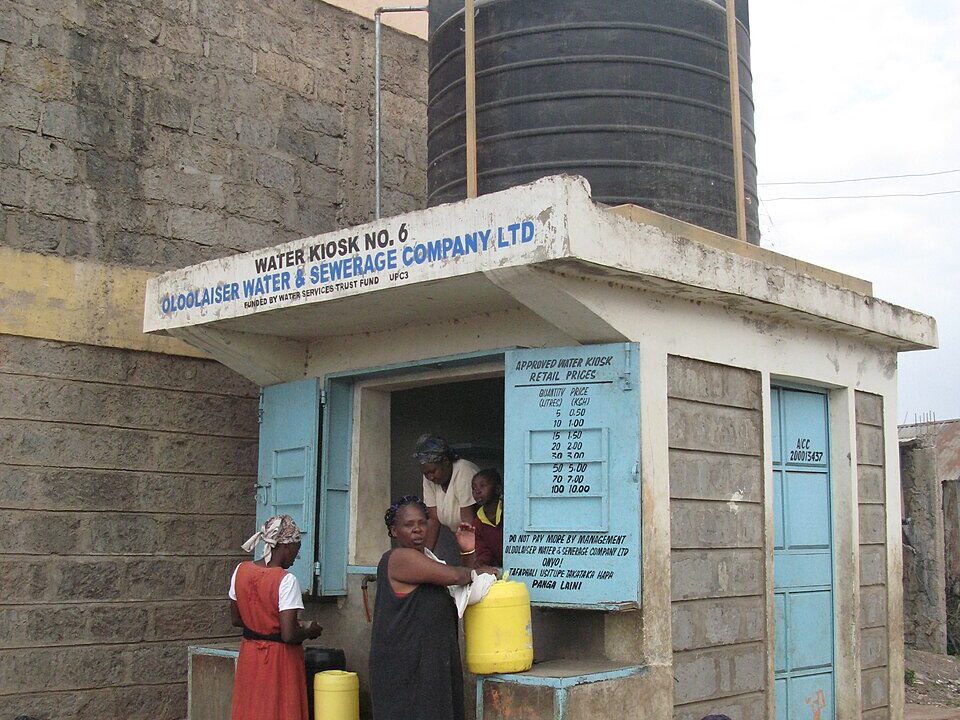
Water affordability is a major issue in Kenya because access to a piped connection does not automatically mean that every household receives water consistently. In some neighbourhoods, residents pay the regulated utility tariff, while others depend on water kiosks, private boreholes, handcart vendors and water tankers.
The difference can be substantial. A household buying water from a vendor may spend several times more per litre than a household receiving a regular supply through a metered connection.
The situation is particularly evident in Nairobi, where households in well-connected estates can receive water through utility pipelines, while residents of informal settlements and areas with unreliable distribution often depend on vendors.
Nairobi City Water and Sewerage Company has an approved domestic tariff of KSh68 per cubic metre for the first six cubic metres consumed monthly in the 2025/2026 tariff structure. This is equivalent to approximately KSh1.36 for a 20-litre jerrycan. Consumption in the next block, from seven to 20 cubic metres, attracts KSh85 per cubic metre.
However, households without reliable connections can pay considerably more. Water purchased from kiosks, private boreholes and handcart vendors attracts additional costs associated with handling, transportation, storage and distribution.
A recent example is Eastleigh in Nairobi, where residents have faced increased water expenses following interruptions in supply. Households have reported spending up to KSh450 daily on vendors, with a 20-litre jerrycan selling for approximately KSh50. One household was purchasing nine jerrycans daily to meet its needs.
The situation demonstrates how water shortages can quickly increase household expenditure, even when the official utility tariff remains unchanged.
In informal settlements such as Kibera, Mukuru and Mathare, the cost difference is also influenced by the distance between households and formal distribution networks. Where piped connections are limited, residents depend on community water kiosks, private suppliers and informal distribution systems.
Research conducted in Mukuru Kwa Njenga found that water prices increased considerably during periods of scarcity. During normal periods, most surveyed households paid KSh5 for a 20-litre jerrycan. During shortages, some paid KSh10, KSh20 or even KSh50 for the same quantity. Household spending on water increased from an average of 2.81 per cent of monthly income during normal periods to approximately 7.4 per cent during water-scarce periods.
Transportation is another important factor. Water vendors who use handcarts and tankers incur expenses related to labour, fuel, vehicle maintenance and the distance travelled to deliver water. These expenses are transferred to consumers through higher selling prices.
In neighbourhoods located far from reliable water distribution points, residents may have to pay more because suppliers travel longer distances to reach them. Households purchasing water in bulk through tankers may also incur additional delivery charges depending on the quantity required and accessibility of the area.
Storage further contributes to the cost. Families experiencing intermittent supply often invest in plastic tanks, underground reservoirs, drums and jerrycans to keep water for periods when taps run dry. Those living in apartments may also share the cost of pumping water into elevated tanks, maintaining storage facilities and operating pumping systems.
For households with limited storage capacity, the financial burden can be greater because they are forced to purchase smaller quantities more frequently, sometimes at higher retail prices.
Reliability is therefore one of the biggest factors determining how much Kenyans spend on water. A household with a connection that receives water regularly can plan its consumption around the utility’s monthly billing system. Another household in the same town may receive water only on selected days and have to purchase additional supplies from private vendors.
Studies on access to water in Kenyan informal settlements have highlighted these inequalities. Residents relying on private suppliers frequently pay more than households with regulated piped connections. Water rationing, limited public water points and informal distribution networks also create challenges affecting affordability and access.
Kenya’s water affordability challenge is also connected to the availability of infrastructure. Expanding treatment capacity, constructing distribution pipelines, extending connections to underserved settlements and improving storage can help reduce dependence on expensive alternative suppliers.
The Water Services Regulatory Board (WASREB) regulates water service providers and approves tariffs, while county governments and licensed water companies play important roles in expanding distribution networks and improving service delivery. The Water Sector Trust Fund also supports projects targeting underserved and marginalised communities.
However, expanding infrastructure alone is not enough if water does not reach households consistently. Utilities must address physical water losses, improve maintenance, strengthen monitoring of distribution networks and ensure that available supplies are shared more reliably.
For consumers, the issue goes beyond the amount printed on a monthly water bill. The real cost includes the money spent buying water from alternative suppliers, transporting it, storing it and ensuring that it remains safe for household use.
Ultimately, making water affordable in Kenya will require more than reviewing utility tariffs. It will depend on improving the reliability of supply, extending formal connections to underserved neighbourhoods, regulating alternative suppliers and reducing the additional costs households incur when water is unavailable through public distribution systems.