







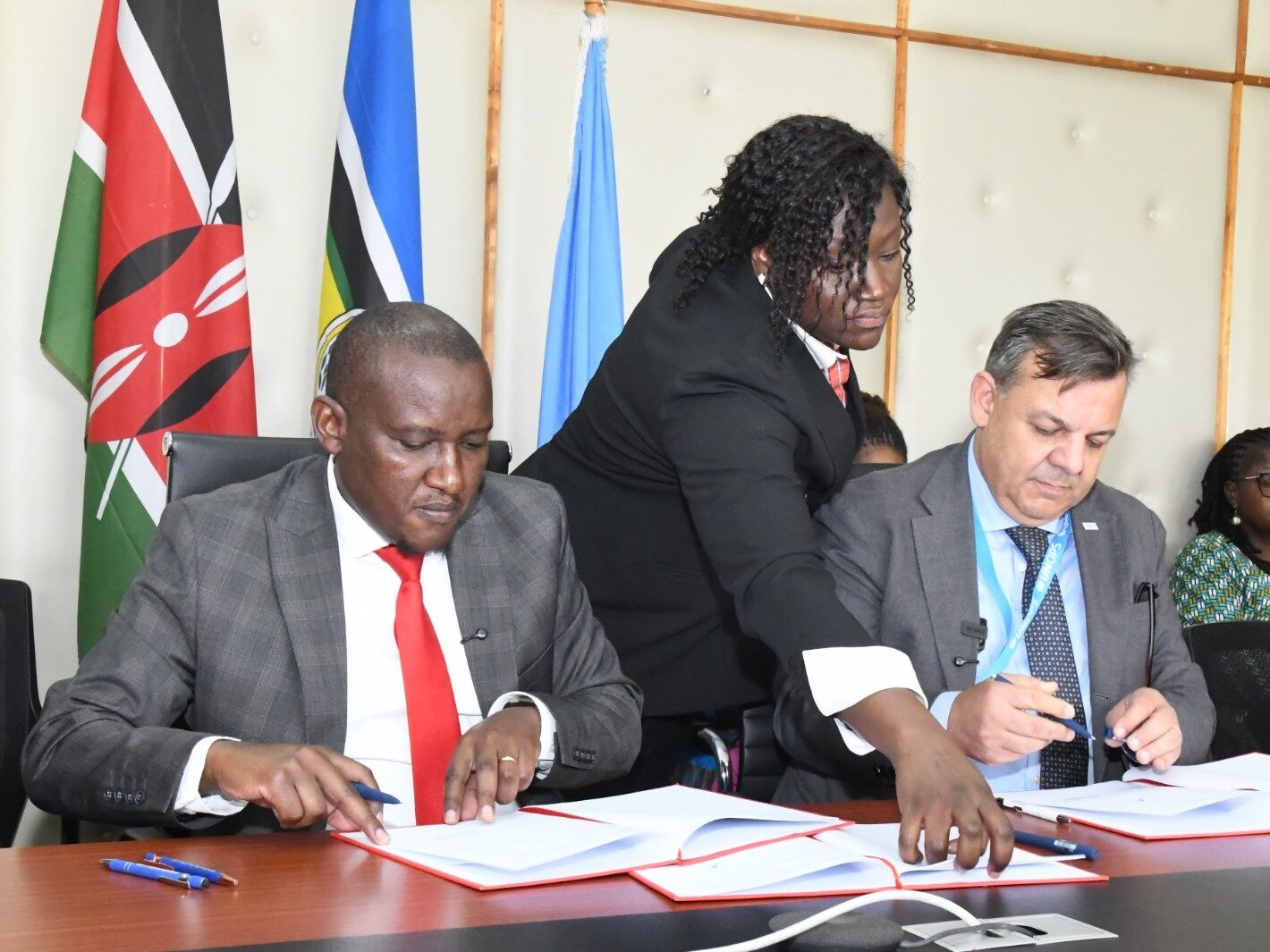
Principal Secretary for Irrigation CPA Ephantus Kimotho signing MOU with United Nations Office for Project Services (UNOPS) East and Southern Africa Director Massimo Diana.
Kenya has entered into a five-year partnership with the United Nations Office for Project Services (UNOPS) to strengthen the planning, financing and implementation of irrigation infrastructure as the government steps up efforts to expand agricultural production and reduce dependence on imported food.
The agreement, signed by the State Department for Irrigation and UNOPS, is expected to provide technical support in developing irrigation projects, preparing feasibility studies, improving procurement processes and mobilising investment for infrastructure development.
The partnership comes as the government rolls out the National Irrigation Sector Investment Plan (NISIP) 2025–2035, which targets an additional one million acres under irrigation over the next decade. The plan also seeks to improve the performance of existing irrigation schemes, increase agricultural productivity and strengthen the country’s resilience to climate change.
Principal Secretary for Irrigation CPA Ephantus Kimotho said the agreement would strengthen the government’s capacity to prepare commercially viable projects capable of attracting financing from both public and private investors.
He said Kenya was seeking to move beyond reliance on government-funded irrigation infrastructure by embracing blended financing arrangements that bring together public resources, development partners and private sector capital.
Under the agreement, UNOPS will provide technical assistance in project design and structuring, feasibility assessments, procurement, environmental and social impact assessments, infrastructure implementation and long-term asset management.
The partnership will also support the preparation of bankable irrigation projects, an important step towards attracting investors and development financing for large-scale agricultural infrastructure.
UNOPS will further assist in strengthening institutional capacity within the State Department for Irrigation, drawing on its international experience in infrastructure development, procurement and project management.
Speaking during the signing, the UNOPS Director reaffirmed the organisation’s commitment to making its technical expertise and institutional resources available to support Kenya’s irrigation development agenda.
The official highlighted project preparation, capacity development, technical assistance and procurement as key areas where the organisation would work with the government to improve the delivery of irrigation infrastructure.
Climate resilience will also form a major component of the partnership, particularly in the design and construction of infrastructure intended to withstand increasingly unpredictable weather conditions.
The UNOPS representative observed that infrastructure damage during floods is not always caused by the volume of water alone, but can also result from poor engineering designs, inadequate construction standards and failure to incorporate climate risks during project planning.
The partnership will therefore seek to integrate climate resilience and sustainability throughout the infrastructure development cycle, from initial project design to construction, operation and maintenance.
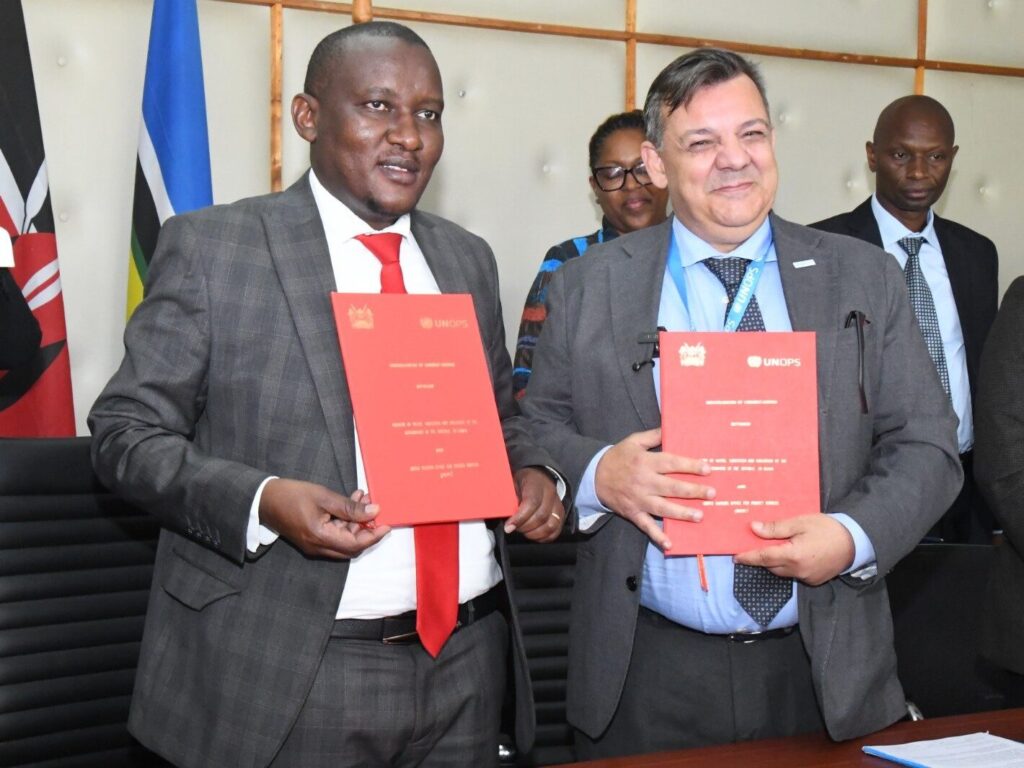
Principal Secretary for Irrigation CPA Ephantus Kimotho after signing of a five-year Memorandum of Understanding (MOU) between the State Department for Irrigation and the United Nations Office for Project Services (UNOPS) Director Massimo Diana.
The agreement comes at a time when Kenya is seeking to unlock more of its estimated 3.35 million acres of irrigation potential. The State Department for Irrigation has previously indicated that only about 21 per cent of this potential is currently being utilised, leaving considerable room for expansion.
Under NISIP, the government has outlined five investment pathways covering farmer-led irrigation development, improved performance of public schemes, corporate irrigation, irrigation development in arid and semi-arid areas, and strengthening community-based irrigation projects.
The investment plan requires approximately KSh598 billion over ten years to expand irrigation by one million acres and optimise the use of existing infrastructure serving another 319,000 acres.
Of the required financing, the government and development partners are expected to contribute approximately KSh233 billion, representing 39 per cent, while private investors are expected to mobilise KSh365 billion, equivalent to 61 per cent.
The financing model reflects the government’s intention to attract greater private sector participation in irrigation development while reducing pressure on public resources.
The National Irrigation Sector Investment Plan also recognises the importance of improving existing infrastructure rather than concentrating exclusively on constructing new schemes. This includes rehabilitating underperforming projects, improving water-use efficiency and strengthening management systems to ensure that irrigation investments deliver sustainable returns.
Rice production is among the key areas expected to benefit from expanded irrigation. Kenya continues to face a substantial gap between domestic rice production and consumption, forcing the country to rely on imports to meet growing demand.
According to the Kenya National Bureau of Statistics’ 2026 Economic Survey, rice paddy production in public irrigation schemes increased by 6.4 per cent to 303,700 tonnes in the 2024/2025 crop year. The area cultivated under the schemes also expanded to 48,379 hectares, while the number of plot holders increased to 36,376.
The figures demonstrate the contribution of irrigation to domestic food production, but also highlight the need for further investment to increase cultivated land, improve productivity and strengthen the country’s capacity to meet rising demand.
The State Department for Irrigation has also been pursuing the modernisation of existing public schemes through improved water delivery systems, mechanisation, solar-powered infrastructure and expansion of irrigated acreage.
The new partnership with UNOPS is expected to complement these interventions by strengthening the technical and financial preparation of projects before implementation.
For the five-year agreement, specific activities will be identified through consultations between the two institutions and undertaken according to project priorities and available resources.
The collaboration also builds on earlier engagements between the State Department for Irrigation and UNOPS, which have focused on technical capacity development, infrastructure planning and improving the quality of irrigation project implementation.
Ultimately, the success of the partnership will depend on translating technical cooperation into well-prepared projects, mobilising the financing required for construction and ensuring that completed infrastructure delivers reliable water to farmers.
As Kenya seeks to expand irrigated agriculture and reduce its exposure to unpredictable rainfall, the government is increasingly looking towards development partnerships and private investment to accelerate infrastructure delivery.
The five-year agreement is expected to provide an additional framework for achieving these ambitions, with the broader objective of increasing food production, improving rural livelihoods, creating employment and strengthening national food security.