





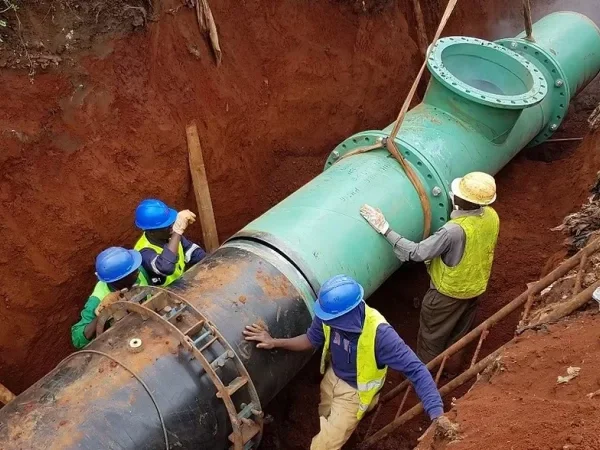
Operational Northern Collector water supply system, which is supplying treated
water daily to Nairobi and surrounding areas. /HANDOUT
Nairobi City Water and Sewerage Company (NCWSC) is accelerating water and sewerage infrastructure upgrades across the capital as the city strengthens its preparedness for anticipated El Niño rains and seeks to improve the reliability of essential services.
One of the latest interventions is taking place along the Dandora dumpsite, where the utility has started relocating an existing water pipeline and installing a new reticulation network to protect critical water infrastructure from environmental and ground-related risks associated with the landfill.
The relocation is intended to move the pipeline away from the active dumpsite, where accumulated solid waste, unstable ground conditions and potentially harmful landfill liquids, commonly known as leachate, could compromise underground water infrastructure. Such conditions can expose pipelines to damage, complicate maintenance and increase the risk of service interruptions.
Heavy machinery has been deployed at the site over the past month to excavate trenches and facilitate the installation of the new pipeline network. Once completed, the intervention is expected to improve the safety of the distribution system, make maintenance operations easier and reduce the likelihood of infrastructure damage.
The project forms part of a wider programme to rehabilitate Nairobi’s ageing water infrastructure, expand distribution networks and improve access to reliable and safe water as the city’s population and demand continue to increase.
NCWSC Managing Director Martin Nang’ole said the utility was prioritising infrastructure rehabilitation, network expansion, reduction of water losses and improvements in service delivery, noting that the ongoing works were part of its long-term development agenda rather than a response limited to the anticipated heavy rains.
He said the company’s five-year strategic plan places emphasis on reducing leakages, accelerating infrastructure development, strengthening operational efficiency and adopting digital technologies to improve customer experience.
The utility’s investments complement major bulk water supply and transmission projects being implemented by the Athi Water Works Development Agency (AWWDA), which is working to increase the volume of water available to Nairobi and strengthen the infrastructure used to deliver it to consumers.
Among the significant developments is the operational Northern Collector water supply system, which provides approximately 140 million litres of treated water daily to Nairobi and surrounding areas. Further investments are targeting the expansion of distribution networks to ensure increased bulk water production translates into improved household connections and more reliable supply.
In western Nairobi, the KSh3 billion Western Nairobi Water and Sewerage Project is expected to improve water supply and sanitation services for more than 300,000 residents. The project includes construction of a 19.7-kilometre high-capacity transmission pipeline connecting Kabete to Olesereni, a 5,500-cubic-metre water storage reservoir in Karen and 63 kilometres of sewer reticulation network.
The targeted neighbourhoods include Kangemi, Kawangware, Dagoretti, Riruta, Uthiru, Kinoo, Kabiria, Ngando and Kirigu, where population growth has increased pressure on existing water and sanitation infrastructure.
Another major intervention is the Central Nairobi Water Network Rehabilitation Project, valued at approximately KSh1.6 billion. The project is introducing trenchless technology to replace deteriorating underground water pipelines while minimising disruption to roads, businesses and households.
The technology allows contractors to rehabilitate or replace underground pipes without necessarily excavating entire road sections, helping address persistent challenges such as frequent pipe bursts, leakages and high levels of non-revenue water.
Nairobi Water is also expanding sewerage infrastructure in several residential areas, including Riruta, Mathare, Kayole and Tassia. In Riruta, the utility has commenced a sewer extension project covering approximately 15.8 kilometres to increase access to sanitation services and accommodate the area’s expanding population.
Other interventions include developing boreholes, improving water storage facilities and extending distribution networks in underserved neighbourhoods. These investments are intended to reduce dependence on limited supply infrastructure while bringing services closer to households.
The infrastructure upgrades are particularly important as Nairobi faces the combined challenges of population growth, ageing distribution networks, inadequate sanitation coverage and increasing vulnerability to climate-related disruptions.
Meanwhile, the Nairobi County Government is implementing a KSh2.4 billion flood-resilience programme to reduce the risk of flooding during periods of heavy rainfall. Of the allocation, approximately KSh2 billion is earmarked for drainage and flood-mitigation interventions targeting 19 roads and other vulnerable locations.
The programme includes clearing blocked drainage channels, removing accumulated silt and solid waste, improving stormwater movement and addressing weaknesses in infrastructure that contribute to flooding.
A multi-agency team involving Nairobi County, the Kenya Urban Roads Authority, Kenya National Highways Authority and disaster-response agencies is coordinating the activities to improve preparedness across the capital.
The county has also outlined a six-point preparedness strategy focusing on restoring the capacity of major waterways, desilting rivers, clearing drainage systems, strengthening emergency response and encouraging residents occupying high-risk riparian areas to move to safer locations.
Approximately 4,500 Green Army workers have been deployed to support drainage clearing, waste collection and environmental clean-up activities. The Nairobi, Ngong and Mathare rivers are among the major waterways receiving attention as authorities seek to improve their capacity to accommodate increased water flows.
Beyond drainage improvements, sewerage infrastructure rehabilitation remains an important component of the city’s flood-preparedness strategy. Heavy rainfall can overwhelm inadequate drainage and sewer systems, increasing the likelihood of wastewater overflows, contamination and damage to surrounding infrastructure.
The wider Nairobi River Regeneration Programme is also undertaking interventions involving construction of trunk sewer lines, rehabilitation of wastewater treatment facilities, riverbank protection and improved stormwater management.
At Dandora, the ongoing dumpsite rehabilitation programme is expected to address leachate pollution and reduce environmental risks affecting neighbouring communities and waterways.
The combination of water pipeline relocation, sewerage expansion, drainage rehabilitation and river restoration reflects the growing need for Nairobi to integrate water supply infrastructure with broader urban environmental management.
As the capital continues to expand, protecting existing infrastructure while investing in additional capacity will be critical to maintaining reliable water services, improving sanitation and reducing the effects of extreme weather.
The ongoing projects therefore serve a dual purpose: strengthening Nairobi’s ability to withstand heavy rainfall while addressing longstanding weaknesses in its water and sewerage systems.