





Kenya is investing billions of shillings in major water infrastructure programmes aimed at expanding access to clean water, improving sanitation and strengthening the country’s ability to withstand prolonged droughts. However, the scale of investment raises an important question: are these projects translating into reliable water services for ordinary households?
The government, development partners and county administrations are financing projects targeting some of the country’s most water-stressed regions. Among the major interventions are the Kenya Water, Sanitation and Hygiene Programme (K-WASH), the Horn of Africa Groundwater for Resilience Programme (HoAGW4RP) and the Mwache Dam project in Kwale County.
These initiatives address different challenges, from inadequate water distribution networks and poor sanitation to groundwater shortages and growing demand in coastal communities.
Their success, however, should ultimately be measured not only by the amount of money committed or infrastructure constructed, but also by the number of households receiving dependable water supplies.
K-WASH is designed to improve water supply and sanitation in 19 selected counties, particularly rural communities that have historically faced limited access to basic services. The programme combines infrastructure investment with reforms intended to improve the performance of water service providers.
The programme also targets institutional weaknesses in the sector, including poor coordination, limited technical capacity and inadequate monitoring of water and sanitation projects. It covers 33 water service providers across the participating counties.
Its importance lies in connecting infrastructure development with the ability of utilities to operate and maintain water systems. Building a water supply scheme does not automatically guarantee reliable services if the operator lacks sufficient resources, technical capacity or functioning distribution networks.
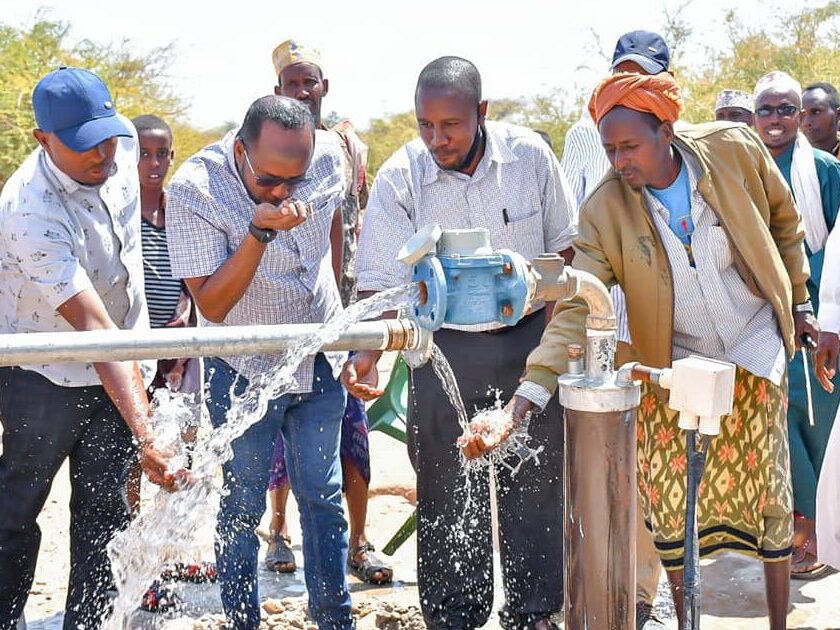
The Horn of Africa Groundwater for Resilience Programme takes a different approach by targeting communities in arid and semi-arid areas where conventional surface water sources are often unreliable.
The World Bank-funded programme has an allocation of US$135 million for Kenya over six years, running from 2022 to 2028. It targets Turkana, Marsabit, Mandera, Wajir and Garissa counties and is expected to benefit more than 700,000 people.
Its interventions include developing and rehabilitating boreholes, improving groundwater information, strengthening aquifer management and supporting infrastructure for communities facing recurring droughts.
The programme also involves the Water Resources Authority, Water Sector Trust Fund, the Ministry of Water and other institutions responsible for groundwater management and service delivery.
Beyond drilling boreholes, the initiative seeks to improve how groundwater is monitored and managed, particularly in areas where communities depend heavily on underground water sources.
Mwache Dam represents another major investment, this time targeting the persistent water shortages affecting the Coast region.
The Sh45 billion multipurpose project in Kwale County had reached 94 per cent completion by October 29, 2026, according to the government update.
The 84-metre-high roller-compacted concrete dam is designed to support water supply and irrigation in Mombasa and Kwale counties. It is expected to supply approximately 186 million litres of treated water daily and improve water security for more than one million people.
However, the project faces an important final-stage requirement: completing the infrastructure needed to move treated water from the dam to consumers.
Financing for transmission infrastructure remains a priority. This means the completion of the dam structure alone will not guarantee that households receive the additional water.
The distinction is important because water infrastructure must function as a complete system, from storage and treatment to transmission and distribution.
The 2026/27 budget provides another way to assess the government’s priorities. The National Water and Sanitation Investment programme has an allocation of approximately KSh44 billion, with specific development allocations including KSh6.127 billion for K-WASH, KSh5.822 billion for Mwache Dam and KSh2.35 billion for the Horn of Africa Groundwater for Resilience Project. These are annual budget allocations, not the total lifetime costs of the projects.
Despite the scale of financing, the impact of these projects will depend on how effectively the government addresses the challenges between infrastructure construction and actual water delivery.
For K-WASH, the critical test will be whether participating counties and water companies can expand connections, improve sanitation coverage and maintain reliable services after construction.
For the groundwater programme, the measure of success will be whether boreholes and other water facilities remain operational, particularly during prolonged droughts. Groundwater resources must also be properly monitored to prevent unsustainable extraction.
At the Coast, Mwache Dam must be supported by treatment and transmission infrastructure capable of delivering its additional water to households, businesses and institutions.
There is also a need for stronger public reporting on project expenditure, contractor performance, completion timelines and the number of people benefiting from each investment.
The Water Services Regulatory Board’s performance reports, county development reports and project implementation updates can help establish whether infrastructure investments are improving service delivery.
Ultimately, Kenya’s water investment agenda should be judged by more than billions allocated, dams completed or boreholes drilled. The real measure is whether families receive safe water consistently, whether sanitation services improve and whether communities become less vulnerable to drought.
The challenge is therefore not simply to build more water infrastructure, but to ensure that every investment translates into measurable and lasting improvements in access to water.