Kenya is expanding investments in groundwater development and underground water storage as part of efforts to strengthen water security in drought-prone regions, where unreliable rainfall and prolonged dry seasons continue to threaten household water supplies, livestock production and economic activities. The strategy is increasingly focusing on capturing excess rainfall and floodwater during wet periods and storing it underground for use when surface water sources decline.
The approach is being implemented through the Horn of Africa Groundwater for Resilience Project (HoAGW4RP), a World Bank-supported programme targeting Turkana, Marsabit, Mandera, Wajir and Garissa counties. The six-year initiative, running from 2022 to 2028, is supported by US$135 million in financing and seeks to improve sustainable access to groundwater while strengthening its management in communities across the country’s arid and semi-arid regions.
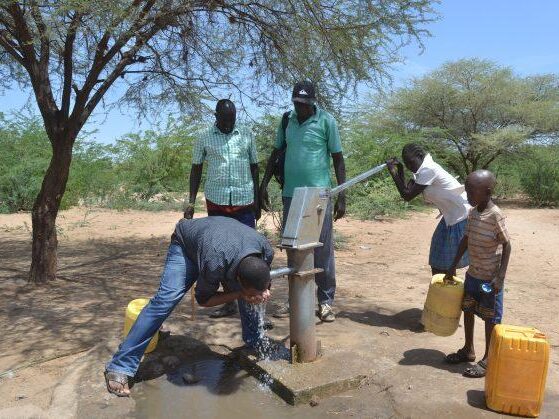
During the November 2026 implementation review, the Ministry of Water reported that 63 rural water supply schemes were under construction across the five counties. Water was already flowing at Nariamao and Loturtur in Turkana County, as well as Aden Awale, Kubeysurur and Barmish in Wajir County.
The programme is also investing in Managed Aquifer Recharge (MAR), a technique that involves capturing surface water during rainy seasons and allowing it to infiltrate underground aquifers for storage. Unlike conventional surface reservoirs, underground storage can significantly reduce evaporation losses, making it particularly useful in arid and semi-arid areas where high temperatures and prolonged dry periods contribute to water shortages.
The Ministry reported that contracts had been awarded for 31 Managed Aquifer Recharge structures, while 45 exploratory boreholes had been contracted to improve understanding of groundwater availability. A tender for drilling at another 82 priority sites was expected to be advertised by the end of November 2026.
The infrastructure will include water pans, sand dams, subsurface dams, infiltration ponds, trenches and other nature-based structures designed to slow water movement and encourage underground recharge. These interventions are expected to help communities retain more rainfall within local catchments instead of allowing large volumes of water to flow away during rainy seasons.
The Water Resources Authority is implementing groundwater conservation activities through Water Resource Users Associations, which are expected to participate in protecting recharge areas and managing the infrastructure. The latest project update indicated that 35 associations were supporting the long-term management of the interventions.
Beyond physical infrastructure, the programme is strengthening groundwater monitoring and information management to improve decisions on where to drill boreholes and how much water can sustainably be extracted. The Ministry reported that development of the Groundwater Information System and its mobile application had been completed, providing a platform for collecting and managing groundwater information.
Kenya’s groundwater strategy is also extending beyond the five northern counties. The Water Resources Authority has identified the need for aquifer assessments, groundwater monitoring and management plans for selected systems, including the Nairobi and Nakuru aquifers, to improve understanding of underground water reserves and protect them from unsustainable abstraction.
The growing investment comes as climate variability increases pressure on conventional water sources, particularly in communities that depend on seasonal rivers, water pans and boreholes. However, groundwater development also requires careful monitoring because excessive abstraction can deplete aquifers, increase pumping costs and undermine long-term water availability.
The success of underground water storage will therefore depend not only on the construction of recharge structures and drilling of boreholes but also on protecting recharge areas, maintaining infrastructure and ensuring communities participate in managing the resources. For Kenya, the longer-term challenge is to turn seasonal rainfall into a more reliable water reserve that can sustain households, livestock and economic activities during prolonged dry periods.