








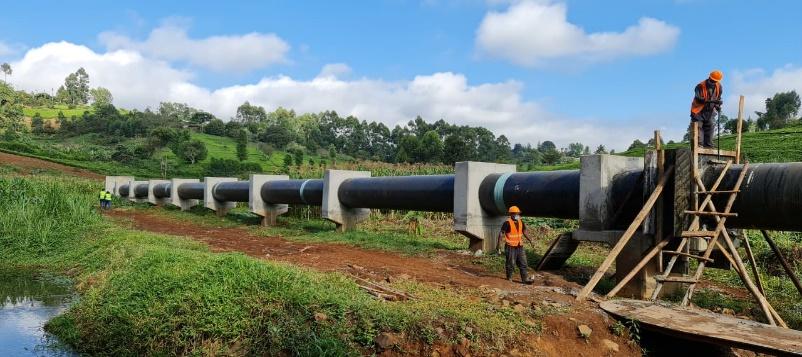
Kenya is planning a major expansion of water infrastructure along the Coast through a proposed Sh50.6 billion project that will involve constructing a 220-kilometre pipeline to increase water supplies to four counties.
The Mzima II Water Supply Project is expected to transport an additional 105 million litres of water daily from Mzima Springs in Taita Taveta County to Mazeras in Kilifi County, improving supplies to Mombasa, Kilifi, Kwale and Taita Taveta.
The project is expected to address a longstanding water deficit in the Coast region, where population growth, urban expansion and increasing economic activities have placed pressure on existing water infrastructure.
China’s Sichuan Roads and Bridges Group has been identified as the proposed private-sector developer for the project, which will be implemented in partnership with the Coast Water Works Development Authority (CWWDA) through a Build-Operate-Transfer (BOT) arrangement.
Under the proposed arrangement, the Chinese firm will finance, design and construct the infrastructure before taking responsibility for its operation and maintenance over a 30-year concession period. Construction is expected to take three years, while the remaining 27 years will cover the operation and maintenance phase.
At the end of the concession, the infrastructure will revert to public ownership and management, allowing the government to retain long-term control of the water supply system.
The proposed pipeline will have a diameter of 1,200 millimetres and will transport approximately 105,000 cubic metres of water daily. The infrastructure will include water abstraction facilities, pumping stations, transmission pipelines and storage facilities to support the movement of water from Mzima Springs to the coastal supply network.
The investment is expected to complement the existing Mzima I pipeline, which has supplied water to the Coast for decades but is increasingly constrained by ageing infrastructure and rising demand.
Commissioned in 1957, the original pipeline was designed to serve a much smaller population. Over the years, deterioration, frequent leakages and pipe bursts have affected its ability to deliver reliable supplies, increasing the need for a modern transmission system.
The scale of the proposed investment reflects the growing gap between water demand and available production in the region. Figures presented to the Senate in June 2026 indicated that the four coastal counties had a combined daily water demand of approximately 512,000 cubic metres against production of 185,000 cubic metres, leaving a deficit of 327,000 cubic metres.
The additional 105,000 cubic metres expected from Mzima II would help reduce the deficit, although further investments in water treatment, storage and distribution infrastructure will be necessary to meet the region’s growing requirements.
Mombasa, in particular, faces increasing pressure from its expanding population and commercial activities. Kilifi and Kwale are also experiencing growing demand associated with residential developments, tourism and other economic investments.
Reliable water supplies are essential to these sectors, particularly the hospitality industry, which depends on consistent access to water to support hotels, restaurants and other tourism-related businesses. Improved bulk water availability could also support industrial development and reduce the cost of obtaining alternative supplies.
The project is therefore expected to play a significant role in strengthening the Coast’s water security while improving the capacity of utilities to serve households and businesses.
However, the project has not yet reached the construction stage. The proposed public-private partnership received approval in August 2024 to proceed to the development and feasibility study phase, with additional regulatory and implementation processes required before construction can begin.
Once implemented, Mzima II is expected to provide a major boost to regional water infrastructure by increasing bulk supplies, reducing pressure on the ageing Mzima I system and supporting the long-term development of coastal towns.