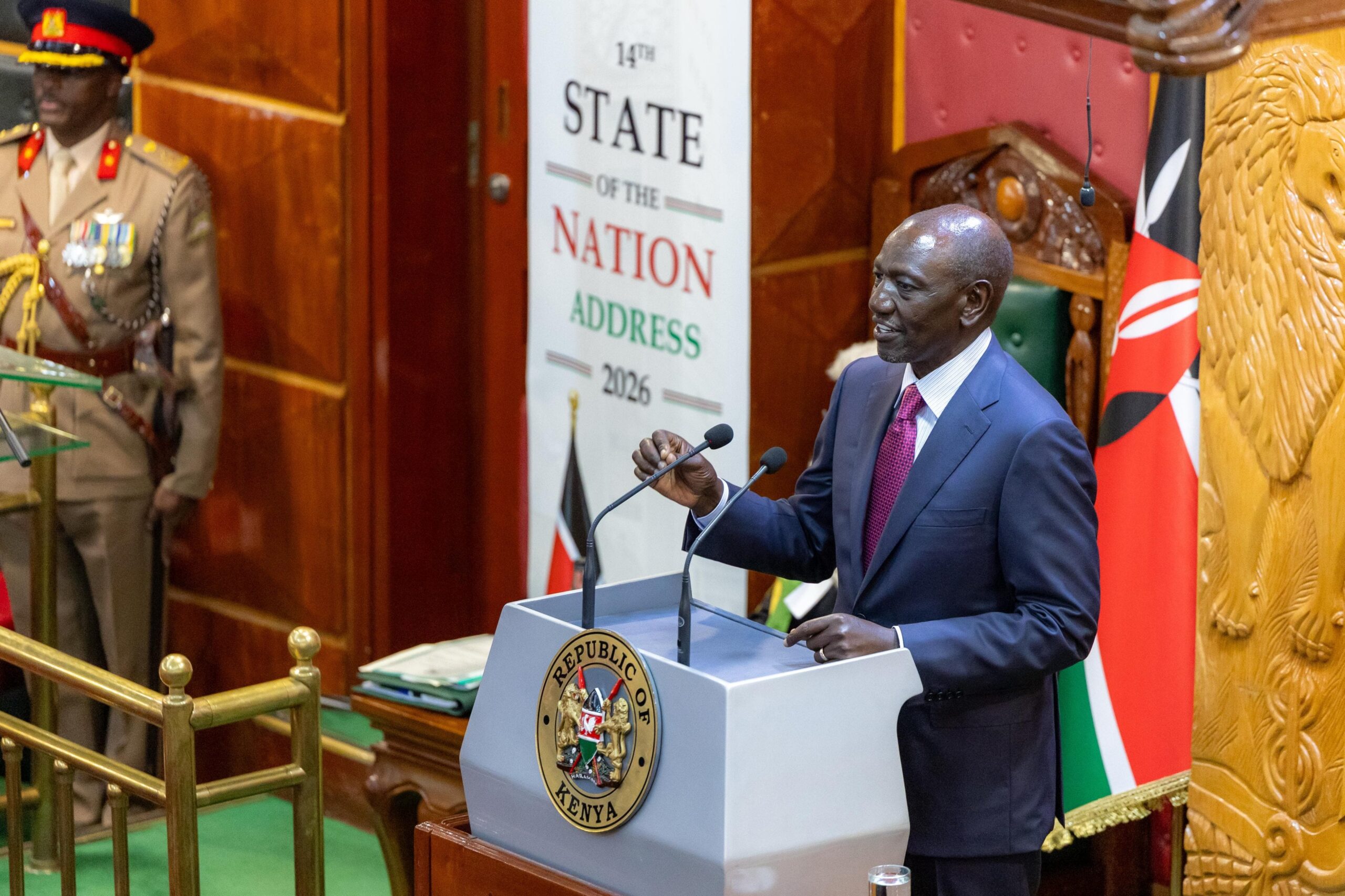






President William Ruto has pledged to construct at least 50 mega dams across the country as part of an ambitious government programme aimed at expanding irrigation, strengthening water security and reducing Kenya’s dependence on rain-fed agriculture.
During his State of the Nation Address, the Head of State said the government plans to complement the mega dams with 200 medium and small dams and thousands of water-harvesting structures, targeting to bring at least 2.5 million acres of land under irrigation.
“Our third priority is water security and irrigation. We have demonstrated through agricultural reforms that Kenyan farmers can produce more when they have access to affordable inputs, better technology and dependable markets,” said Ruto.
He observed that Kenya’s agricultural potential would remain constrained as long as production depended heavily on rainfall, adding that reliable water supplies were necessary to support agriculture, industry and households throughout the year.
“Our programme envisages at least 50 mega dams, 200 medium and small dams, and thousands of water-harvesting structures, supporting an ambition of at least 2.5 million acres under irrigation,” he said.
The ambitious programme comes against the backdrop of Kenya’s vulnerability to climate change, prolonged droughts and increasingly unpredictable rainfall patterns. Agriculture remains a major pillar of the country’s economy, but much of the sector is rain-fed, exposing farmers to crop failures, reduced harvests and food shortages whenever rains fail.
According to government estimates, only about 15% of Kenya’s land receives sufficient rainfall to support rain-fed agriculture. The remaining 85%, largely comprising arid and semi-arid lands, requires alternative water sources to support meaningful agricultural production.
Kenya has an estimated irrigation potential of approximately 3.35 million acres. However, the National Irrigation Sector Investment Plan indicates that only about 747,000 acres were equipped for irrigation by 2023, representing roughly 21 per cent of the country’s potential. This leaves significant room for expansion.
The government has also been implementing various irrigation initiatives, including the National Expanded Irrigation Programme, community-based irrigation projects and the rehabilitation of existing schemes such as Mwea, Bura and Ahero.
Under the National Irrigation Sector Investment Plan (NISIP) 2025–2035, the government seeks to expand irrigated land to 1.5 million acres by 2035 through public investment, private-sector participation and farmer-led irrigation development.
The proposed dams are expected to provide water for irrigation while supporting domestic consumption, livestock production, industrial development and hydropower generation where applicable.
However, delivering the ambitious targets will require substantial financial investment, effective project implementation, environmental safeguards and sustainable water-resource management.
If successfully implemented, the programme could transform agricultural production, particularly in northern Kenya and other arid and semi-arid regions, while improving food security, creating employment and reducing the country’s exposure to drought.
“Roads will connect producers to markets. Energy will power production. Water will secure agriculture and industry. Together, these investments will create the conditions for a more productive, competitive and resilient economy,” Ruto said.
Ruto promises to build 50 mega dams to boost irrigation and water security