



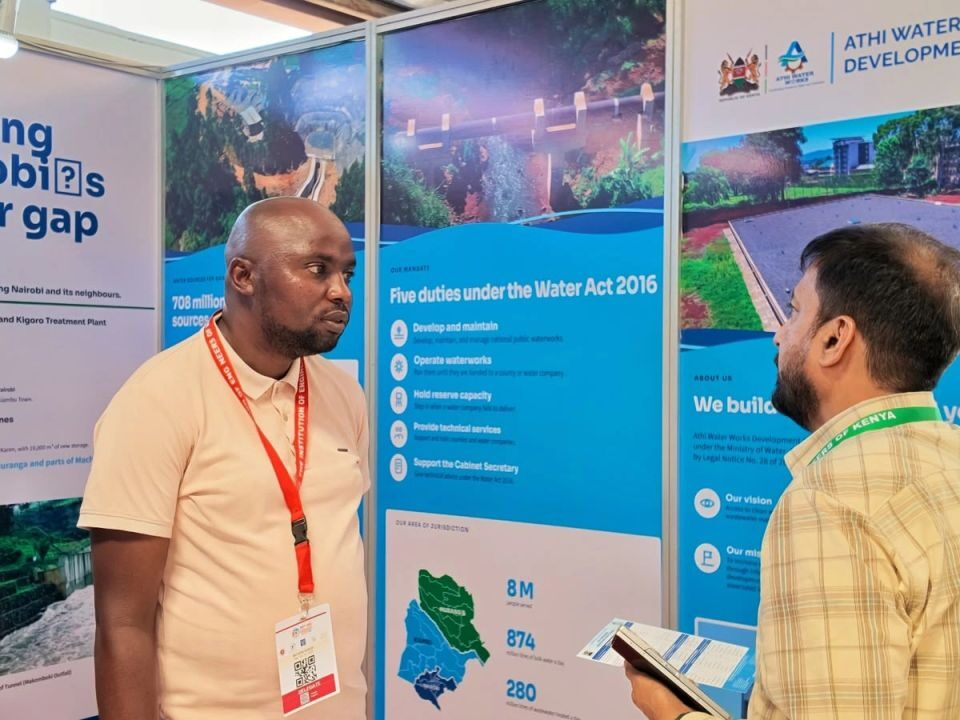
The Athi Water Works Development Agency (AWWDA) is showcasing its water and sanitation infrastructure projects at the 33rd Institution of Engineers of Kenya (IEK) International Convention in Mombasa, highlighting the role of engineering innovation in expanding access to reliable water and sanitation services.
The convention, which began on November 24, 2026, is being held at PrideInn Paradise Beach Resort and Spa under the theme, “Intelligent Systems for Accelerated and Sustainable Growth.” It brings together engineers, industry professionals and other stakeholders to discuss emerging technologies, infrastructure development and sustainable engineering solutions.
Through its exhibition stand, AWWDA is presenting its mandate, ongoing projects and key achievements in the development and operation of bulk water and sanitation infrastructure. The exhibition provides delegates with an opportunity to understand the agency’s contribution to expanding water supply capacity, improving sanitation infrastructure and supporting service delivery in its areas of jurisdiction.
The agency’s participation also provides a platform for engaging engineering professionals, technology providers and other industry players on approaches to improving infrastructure planning, construction and management.
Bulk water infrastructure plays a critical role in Kenya’s water supply chain by connecting major water sources and treatment facilities to distribution networks operated by water service providers. Investments in transmission pipelines, storage facilities, treatment plants and wastewater systems are essential in meeting growing demand from households, businesses and industries.
In Nairobi and surrounding areas, population growth and urban expansion have increased pressure on existing water and sanitation infrastructure, creating the need for additional production capacity, improved distribution networks and expanded wastewater treatment facilities.
The convention’s theme places particular emphasis on the application of intelligent systems and modern technologies in accelerating sustainable development. In the water sector, these include digital monitoring systems, automation, geographic information systems and data-driven infrastructure management.
Such technologies can help infrastructure agencies monitor water networks, identify leakages, detect equipment failures, improve treatment processes and plan maintenance more efficiently. They can also support better management of water resources and strengthen the resilience of infrastructure against climate-related pressures.
Reducing water losses and improving operational efficiency remain important priorities for water utilities, particularly in areas where demand continues to exceed available supply. Smart metering, real-time monitoring and improved asset management can help operators identify weaknesses in distribution systems and make better investment decisions.
The convention also provides an opportunity for AWWDA to exchange knowledge with other engineering institutions and industry professionals on construction standards, emerging technologies and sustainable infrastructure solutions.
Collaboration between engineering agencies, research institutions, technology providers and other stakeholders is increasingly important in addressing the technical and financial challenges associated with developing large-scale water and sanitation infrastructure.
For Kenya, expanding access to safe water and sanitation will require not only increased investment in physical infrastructure but also the adoption of efficient technologies and engineering practices that improve the performance and sustainability of existing systems.
AWWDA’s participation in the convention therefore provides an opportunity to showcase its infrastructure development work while engaging with professionals on innovations that could shape the future of water and sanitation service delivery.
The agency continues to use such industry engagements to strengthen technical collaboration, share project experiences and promote sustainable approaches to bulk water and sanitation infrastructure development.